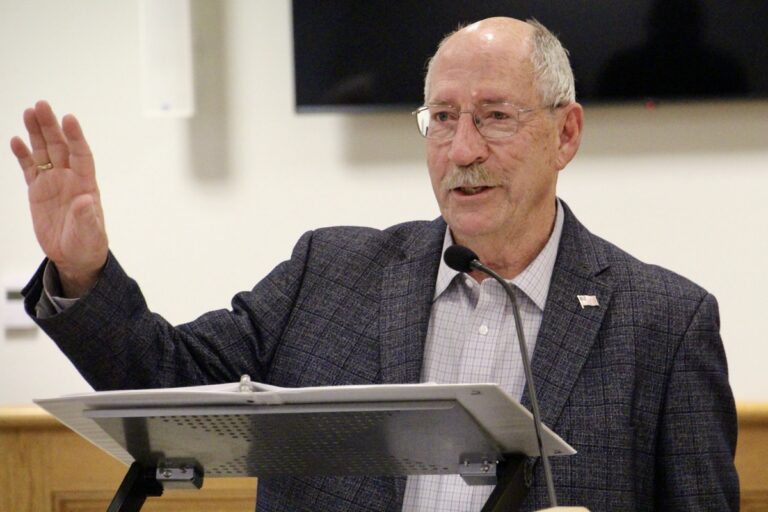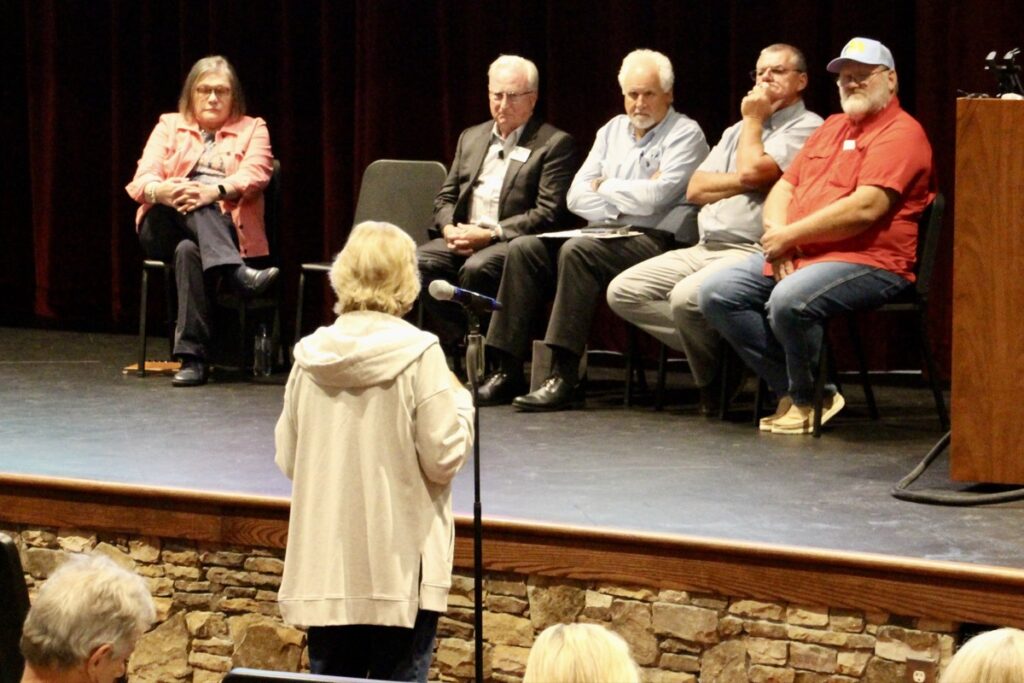
More than 100 people attended the FLOST Town Hall hosted by Union County Sole Commissioner Harold Collins at the Fine Arts Center on Thursday, Sept. 4.
Collins called the Town Hall primarily to educate the public on the new sales tax, which was created as part of Georgia House Bill 581 that became law last year and was ratified in a statewide constitutional amendment vote in November 2024.
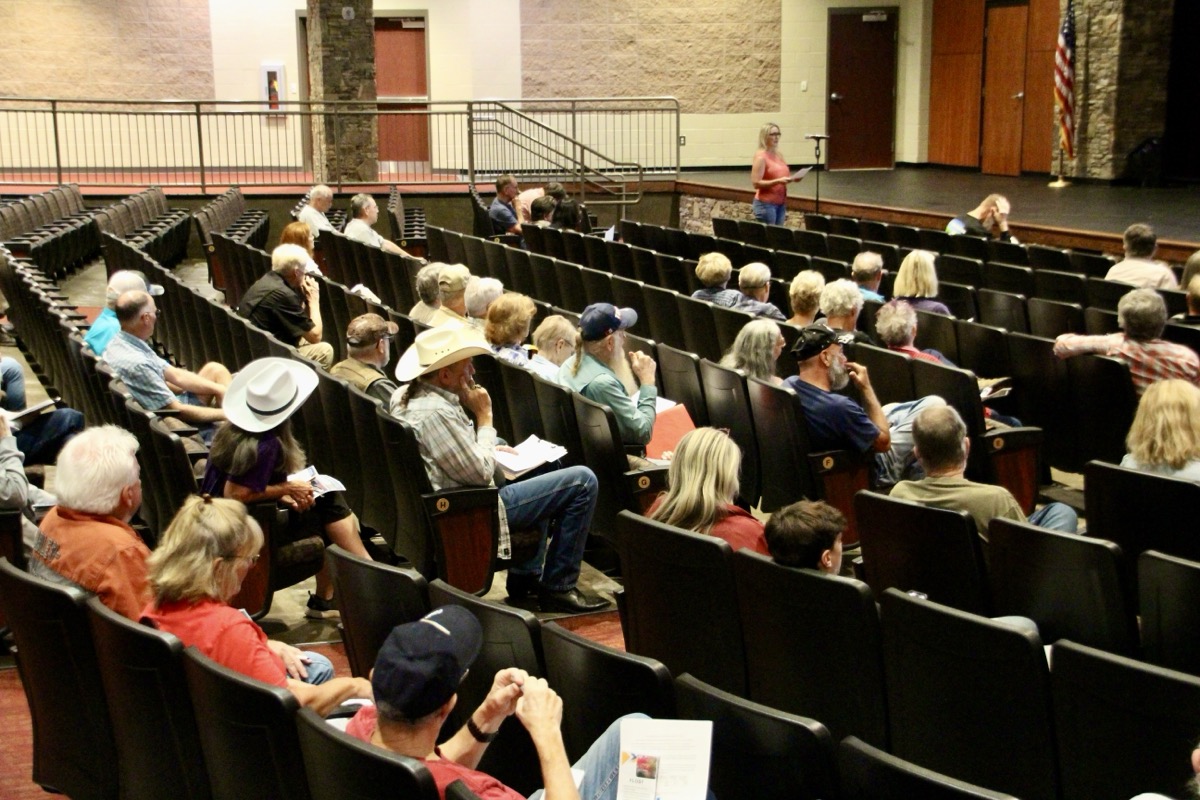
Fourteen people asked questions and/or offered statements, showcasing a variety of opinions on the newly proposed sales tax, which must be used “exclusively for tax relief” to uniformly reduce the county and City of Blairsville portions of property taxes for all property owners.
The event started with a panel of speakers making a series of brief presentations concerning the Floating Local Option Sales Tax. Collins has called an election for FLOST to appear as a referendum for local voters to support or reject in the Nov. 4 Special General Election.
If it passes, FLOST will result in an additional 1% sales and use tax in Union County starting Jan. 1, 2026, raising the total sales tax that everyone pays to 8% for every dollar spent on eligible goods and services at places like grocery stores and other retail establishments.
The trade-off to the sales tax would be a steep reduction in the county and city millage rates, estimated at about a 70% savings on local property taxes. Importantly, FLOST would only result in a rollback to county and city rates, not the levy for Union County Schools.
Phil Sutton sat on the county panel. Sutton is the consultant Collins hired to prepare the FLOST referendum for November. He said Union County already enjoys one of the lowest tax rates in the state and that FLOST would bring the county millage to the absolute lowest in Georgia.
Sutton demonstrated the real-world value of FLOST, presenting examples of the annual property tax savings the new sales tax would produce for individual property owners.
For a property valued at $400,000 – the median home price here – FLOST would reduce a property tax bill of $661 to about $202 for a $459 savings. Inside the city, the savings would be even greater, as the combined property tax cut on a $400,000 property would be $583.
The county produced a handout for the meeting estimating the annual cost of the new FLOST tax as $180 per resident based on “the estimated median sales tax collected per person statewide,” which is comparably less than the property tax savings on a median-valued home.
Sutton projected the five-year FLOST would raise about $47.5 million based on 15 years of prior sales tax collections. He shared that the best calculation available, though imperfect, implied that non-residents would pay the lion’s share of the new tax at around 65% of collections.
A successful FLOST would begin collections next January, and it would have to be collected for a year before it could be applied as a tax rollback split between the county and city based on their respective property tax collections. So, property tax relief would start in 2027.
Tax Commissioner Lee Knight also presented, walking people through an explanation of tax bills and how they are calculated. Knight recommended people visit https://www.uniongatax.com/ to find all kinds of useful information, including personalized tax bills and payment status.
County Finance Director Kay Wilcox used slides to summarize the law pertaining to FLOST and discuss how collections would be incorporated into the county budget as restricted funds.
Wilcox highlighted the fact that FLOST would be revenue neutral in nature, meaning it could not serve as additional revenue for the county and city but only as replacement revenue to offset property tax collections for the maintenance and operation of local government.
FLOST Q&A
Public sentiment ran the gamut from clear support to outright rejection to curiosity about the mechanics of FLOST.
Several residents, including property owners, expressed concern for low-income individuals, especially those who do not own property and will therefore not see a corresponding reduction in their overall tax burden, as all people will have to pay the extra sales tax – residents, visitors, property owners, renters, etc.
One attendee described sales taxes as “regressive,” in that they have a larger impact on people with low incomes, while property taxes, which stand to be reduced, are a “progressive tax” that disproportionately affect people with higher incomes who are more likely to be able to afford it.
For people who live here but do not own property, their taxes will only be going up as they continue to purchase necessities like groceries, though members of the county panel suggested renters would be less likely to see housing cost increases if their landlords get a tax break.
Also pointed out, any property tax savings would not be a true savings calculation for property owners, as the reduction in property taxes would coincide with an increase in taxes at the cash register, even if the amount spent on extra sales tax did not completely erase the property tax savings.
Another resident asked about the impact to needed workforce recruitment given that people who are hoping to move here for employment before becoming future property owners will be faced with a higher cost of living from the additional sales tax.
County Attorney William Mercer, who mediated the Q&A, responded that low property taxes make this a more attractive place for people to move as future property owners, and Sutton noted that even an 8% sales tax would be in line with most other counties in Georgia.
A local business owner said that, as a “sales tax generator,” he could not support FLOST because he felt confident the 8% rate would drive potential customers to buy from competitors in nearby lower sales tax counties, depriving his company of sales and the county of sales tax proceeds.
Some attendees expressed skepticism or confusion about the $180 figure related to median annual sales tax paid per person, asking how accurate the calculations were likely to be regarding the percentage of non-residents who supposedly pay for most of the sales taxes here.
Sutton said the estimates were derived from a formula that takes the entire state into account, but he added that other data support the conclusion, including that Union is in the Top 11 of all 159 Georgia counties for sales tax collections compared to expectations based on local population.
On the clearly supportive side, one resident said the county must get the money it needs to run one way or another, and that while she hopes the budget is trimmed as much as possible, the burden to maintain and operate local government in an increasingly expensive environment “shouldn’t just be (on) the property owners.”
Still another attendee asked if people liked the LOST rollback, which cuts the county millage rate by over 3 mills each year. He wondered if anyone would be in favor of reversing the LOST rollback, and if not, he reckoned they would be in favor of doubling that savings with FLOST.
Of course, sales tax collections are not guaranteed; FLOST could result in greater or lesser revenue than projected, translating to either a larger or smaller county property tax break as collections come in over the next five years. Regardless, the county and city must continue to operate.
If sales tax collections start on a downward trajectory, the county and city might have to raise their property tax rates in the future even if such increases would still likely result in smaller property tax bills than today due to the offsetting FLOST – at least for a time.
Conversely, if sales tax collections continue to rise over the next five years, FLOST could completely eradicate county and city property tax bills, and there is a renewal process the county could follow to get FLOST back before voters to preserve the savings down the line.
No matter how things turn out, the Commissioner’s Office is giving local voters the chance to decide the issue for now in the upcoming election.
Looking ahead, the 2026 mid-term elections will put other important matters before Union County voters.
Expected to appear on ballots next year are both SPLOST and ESPLOST, which would not be new sales taxes but continuations, as well as the question of whether residents want a multi-member board of commissioners instead of a sole commissioner style of county government.