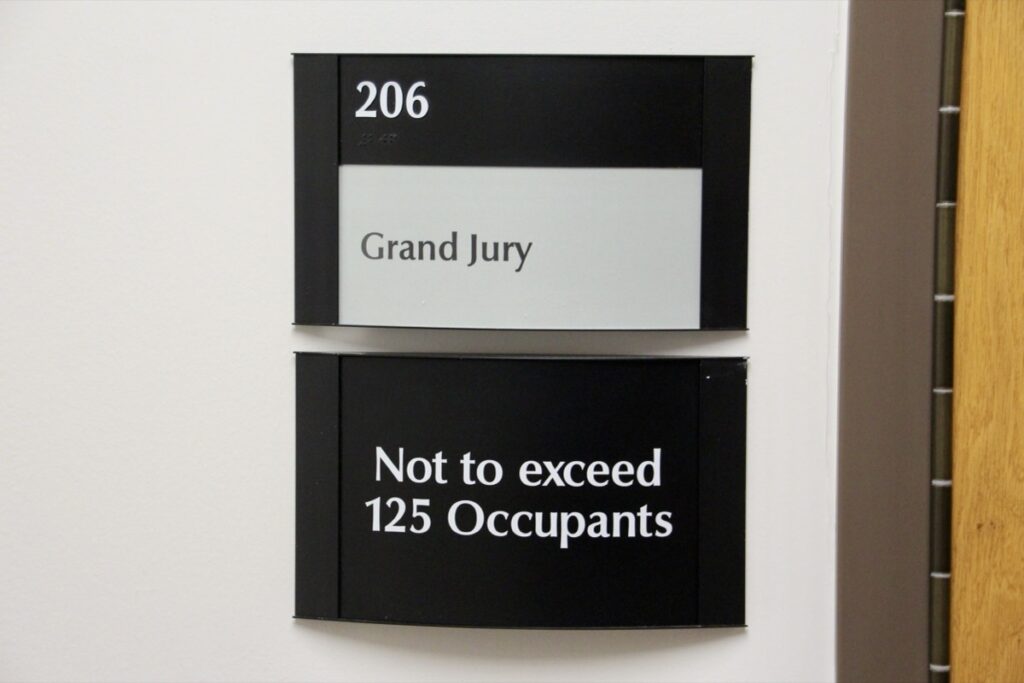
Many people are familiar with the indictment process of the Union County Grand Jury, which regularly results in official charges being filed against alleged criminal offenders.
And while the Grand Jury spends most of its time hearing evidence to decide whether to formally charge people accused of crimes, the deliberative body serves other purposes as well, like making certain county-level appointments and inspecting public offices and facilities.
Grand jurors also act as an important safeguard against unwarranted prosecutions by providing a citizen-led check and balance on the criminal justice system.
Here in Union County, the Grand Jury is empaneled with 23 new members twice each year, once in January and again in July.
Similar to criminal jury selection, grand jurors are randomly chosen from among the 18-and-up population of local U.S. citizens who have lived in the county at least six months, do not have felony convictions, have not been declared mentally incompetent, and are not elected officials.
And like criminal trial jurors, grand jurors are paid $35 a day as compensation for their time, and many jurors must be excused from work to perform their legal duties.
That’s essentially where the similarities between the two types of jury end; simply put, a grand jury decides if there is enough evidence to initiate a prosecution in the Union County Superior Court, while a criminal jury decides guilty or not guilty at trial based on that evidence.
Enotah Judicial Circuit District Attorney Jeff Langley and his office act as the designated legal advisers for the Grand Jury, presenting criminal cases to grand jurors and providing them with any requested information and legal advice.
Based on the evidence his office presents, to include law enforcement testimony, Langley said the Grand Jury can vote yes to bring charges, which creates what is known as a “true bill of indictment” consisting of written accusations against an alleged offender.
Or, members can vote no, thereby declining to bring an official charge or charges if they are not convinced by a case or elements of a case.
“Basically, a Grand Jury is a check on the power of the prosecutor and law enforcement to bring serious cases,” Langley said. “The Grand Jury checks them off to say, ‘Yes, there’s probable cause … They may be innocent, or they may be guilty, but there’s enough evidence here that is justified to go forward (to trial).’
“It’s a protection for the citizen against a capricious prosecution that has no basis.”
Members of the Grand Jury can even come up with their own criminal charges and direct the district attorney to present said charges to them, but Langley said that’s a very rare occurrence.
“They don’t have specific information to do that, usually,” Langley said. “Usually, it’s our office creating an indictment and presenting it to them, and then they vote on that indictment, but they can direct me to change the indictment.
“Almost always, those indicted are people who have already been arrested by law enforcement, but they can indict someone who hasn’t been arrested by law enforcement. And then, that generates a bench warrant stemming from the Grand Jury for that person to be arrested.
“But that’s fairly rare. We do that in maybe 1 out of 100 cases – probably less than that.”
Grand jurors meet at least twice during their six-month term, as state law requires that people incarcerated without bond or the ability to make bond be formally charged within 90 days of being arrested.
In a typical term, a Grand Jury will meet for a total of three or four days inside the Union County Courthouse, though additional meetings can be called by the District Attorney’s Office depending on the prosecutorial workload.
On top of its indictment powers, the Grand Jury is responsible for providing oversight of the various elected official offices in the county by receiving written reports on the finances and operations of each.
If eight or more members deem it necessary, the Grand Jury is also empowered to investigate any and all public offices, buildings, authorities and records and even has subpoena power to compel witnesses to appear for questioning in such matters.
At least once each year, the Grand Jury must inspect the conditions and operations of the county jail, at which point members receive a tour from the Union County Sheriff’s Office.
And in Union County, the Grand Jury is tasked with making appointments to the Board of Equalization and nominations to the Board of Registrars.
Additionally, the Grand Jury can make constructive, nonbinding recommendations that are published at the conclusion of each meeting as part of the official presentments.
Self-generated by members of the Grand Jury, recommendations are made on majority vote and are merely suggestions to the public offices they pertain to. Some recommendations are fairly common and recur every so often among different grand juries, like the building of a new jail.
This month, for example, the Grand Jury recommended that the Sheriff’s Office obtain dash cameras for patrol cars; that the county pursue the construction of a larger jail with courtroom capabilities; and that the county gauge public interest in and seek a location for a paved bike trail/recreation path.
If they wish, county officials may choose to follow the recommendations from the Grand Jury but are not beholden to them.
“For the department heads and elected office holders, it’s 23 citizens voting on something saying, ‘We think this should happen,’ or ‘This would be a good idea,’” Langley said. “Wise leaders should carefully consider anything 23 citizens recommend, but there’s no cost analysis or feasibility study or anything like that behind it – it’s just what these citizens would like to see happen.”
Added Langley, “We’ve had several grand juries in the past recommend a new jail. The challenge for that is, a new jail is a very expensive, huge project for the county to undertake. Therefore, they’ve always been hesitant to do that.”
Langley acknowledged that a new jail will be needed at some point but said that such a major expense – potentially in the tens of millions of dollars – would require considerable public deliberations by elected officials and voters alike.
“It’s a huge decision for the county on when and how to build a new jail – it’s a big investment,” Langley said.
Former Commissioner Lamar Paris purchased the Old Shoe Factory property in 2020 as a future jail site. But there has never been an established timeline on building a new jail, and it seems highly unlikely that the Grand Jury recommendation this month will get the process started.
Langley said that such recommendations used to carry more weight under the old grand jury selection process, which until 2012 required that a local committee fill the grand jury pool with “the most intelligent and upright members of the community.”
“But (state lawmakers) changed that in 2012 to make anyone that had lived in the county for at least six months eligible to be on the Grand Jury,” Langley said. “So today, there’s no selection process that intentionally puts prominent people on the Grand Jury in the way that previously existed.
“Under the old law, where a committee picked names, put them in a pool, and then it was randomly selected from that select pool, you tended to have a lot of community leaders on the Grand Jury, and therefore a recommendation had an impressiveness or authority to it.”
Importantly, Georgia law makes clear that grand juries are “meant to be non-political bodies,” Langley said, and therefore recommendations are statutorily prohibited from containing personal attacks.
Langley noted that the Grand Jury “is not a public forum,” so residents who are not empaneled cannot simply come in and observe the grand jurors’ work.
“By law, it’s a secret proceeding,” Langley said. “And the reason for that is, the Grand Jury can make an inquiry about whether or not somebody committed a crime. Hearsay is allowed in Grand Jury, but it’s not out in the public courtroom except for certain exceptions.
“And therefore, things could be said about someone that shouldn’t be out there in the public because it turns out not to be true, and someone could be slandered if the public is allowed to come in and observe Grand Jury.”
The only information that is publicly available regarding Grand Jury deliberations are the presentments, including indictments and attached reports, that are signed off by the Superior Court Judge, filed in the Superior Court Clerk’s Office, and published in the legal organ.
Langley said the Grand Jury can invite or command someone to come speak to them, “but the general public can’t just say, ‘I want to speak to the Grand Jury and take up the Grand Jury’s time’; that’s up to the Grand Jury.”
Presentations from the public are not common but can occur if eight or more grand jurors decide to invite someone in, with the idea that such presentations might spur a majority of the Grand Jury to support, for example, a specific recommendation from other community members.