Every five years, Union County’s first responders review their Disaster Mitigation Plan, and with the advent of 2025, that time has rolled around again.
Updated planning started on Jan. 30 with a meeting that served as a sort of introduction to a process that will unfold over two more upcoming meetings.
Local Emergency Management Agency Director David Dyer explained before the meeting that mitigation, considered “the bottom line” of a response, acts as a roadmap. One way to view it is as a customized plan to address a community’s needs based on local occurrences.
“If something’s going to happen, let’s try to make it to where it’ll have the least amount of impact on us as possible,” Dyer said.
According to Dyer, an initial look at Union County’s greatest risks puts the most likely ones in the category of natural disasters. There’s no way of totally predicting large-scale, catastrophic events prepared for by these sorts of meetings, but the most likely events involve nature’s wrath.
Regardless of the type of disaster, first responders work to address them before they happen by planning, in this case with the help of third-party specialists.
“So, a contractor will come in, and we’ll have these meetings … to bring people from the public, other organizations, private organizations – anybody who wants to have any input into the plan – to be able to sit with us and come up with strategies and issues and problems,” Dyer said.
Data collected in the meetings will then be used to come up with a renewed plan. From there, it must be approved by the Georgia Emergency Management and Homeland Security Agency before a review by the Federal Emergency Management Agency.
If accepted at the state and federal levels, the plan will then return to Union County. The document continues its role as an outline that can be pulled out and consulted regularly, with detailed strategies in place for multiple grave situations.
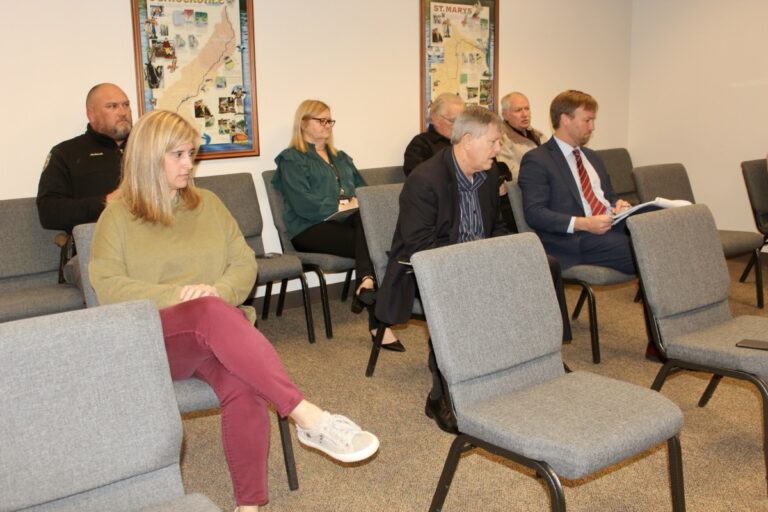
Hosted by Katy Westbrook of Lux Mitigation and Planning Corporation, the very first meeting involved talking about potential disasters and how to handle them. After a short recess for lunch, attendees reconvened for an exercise meant to help shape local plans for disaster readiness.
First, Westbrook prompted the audience – made up mostly of first responders from various local public safety departments but also including everyone from active citizens and retirees to bankers and hospital staff – to list “things that could go wrong.”
Wildfires, severe thunderstorms and tornadoes were just a few of the items on the list, which included other categories like infrastructure breakdowns and solar flares. Taped to a whiteboard at the front of the room, the events were then examined and ranked in different categories.
Westbrook asked the audience to number the issues based on likelihood of occurrence, then on how prepared they believe the county is to handle each. The exercise culminated in rating the impact each bad event might have on the community.
As noted, all opinions were subjective and liable to change; for example, a mass shooting event or a landslide might shift the focus of those threats toward greater concern. Following past patterns, community members identified natural disasters as the most likely to occur, with severe storms, inclement weather and wildfire taking the lead.
Still, there was some concern over “manmade” disasters, such as civil unrest or terrorist attacks, and with the COVID-19 pandemic still fresh on people’s mind, the possibility of a recurring epidemic – or worse – was not lost on many attendees.
Two more meetings are anticipated before the updated plan is finalized. After aggregating data from the Jan. 30 meeting, the next steps are to come up with ways to respond to these potential problems and look at Union County’s capabilities of doing so.
The next two meetings are set for Feb. 27 and March 27. The public is encouraged to attend at Fire Station No. 1 on Shoe Factory Road.