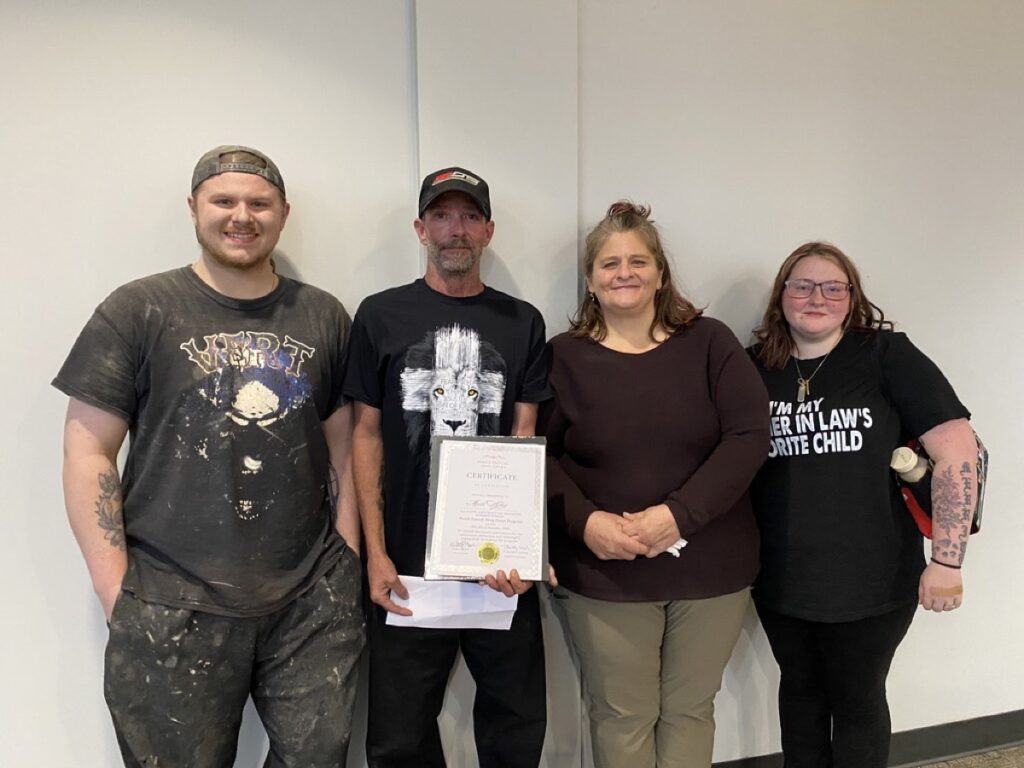
The North Enotah Drug Court marked its fourth-quarter graduation on Thursday, Dec. 18, at North Georgia Technical College, honoring one graduate whose journey has stood as a testament to perseverance, accountability and hope.
Mark Kelley of Union County completed the program, a 24-month intensive alternative to incarceration for individuals facing drug- or alcohol-related charges.
The ceremony brought together family, friends and community leaders, including Enotah Judicial Superior Court Judge T. Buckley Levins, NGTC President John Wilkinson, NGTC Blairsville Campus Director Matthew Mashburn, Union County Sole Commissioner Harold Collins, and Wade Green, newly appointed North Enotah Drug Court case manager.
Drug Court accepts participants referred by community stakeholders such as public defenders. Candidates are screened across legal and clinical criteria within 30 days, with violent offenders excluded.
Each participant follows an individualized plan that includes counseling, life skills training, employment assistance, and support in securing stable housing. Graduates continue receiving guidance through probation officers, recovery sponsors, and relationships built during the program.
Judge Levins opened the ceremony by reflecting on the value of the work being done. Speaking to the significance of a single graduate, he reminded the room that “a life is priceless,” as is family and redemption. He described Kelley as an exemplary model for younger participants, noting his willingness to confront adversity rather than retreat from it.
Levins also spoke candidly about attending the funeral of Kelley’s grandchild during his time in the program, a moment that could have derailed recovery. Instead, Levins said, Kelley leaned into the support of the drug court community and his family, choosing resilience over relapse.
The judge presented Kelley with a certificate of completion and a commemorative sobriety coin.
Keynote speaker John Wilkinson shared his own family’s experience with addiction, including the loss of his son-in-law, and offered advice passed down from his father: to take life one day at a time, with faith and perseverance.
When Kelley took the podium, emotion filled the room. Reading his letter to the governor and reflecting on the circumstances that brought him to drug court, he spoke openly about events leading up to his final arrest and how this program saved his life. Holding back tears, he expressed gratitude for the staff, the court, and especially for Judge Levins’ willingness to show up when it mattered most.
“You hear a lot of people say, ‘If you need anything, just call me, I’ll be there.’ You call and a lot of people don’t show up,” Kelley said. “But you did. That means the world to me.”
He also recalled an early assignment where participants were asked to write down their hopes and dreams: “It was nice to have those hopes and dreams again,” he said.
Kelley shared his plans to continue attending church, remain active in recovery, and help others seeking sobriety, crediting the community for giving him back his life.
Family members and fellow graduates echoed that sentiment. Kelley’s wife, Rebecca, described the moment not as an ending, but as a beginning, praising his determination and strength.
“You have turned your darkest moments into a testament of resilience,” Rebecca said. “I don’t just see a graduate of this program. I see a warrior.”
Fellow graduate David Goyette encouraged continued commitment, reminding Kelley that life improves when one step follows another.
“If we want our old life, we can always go back to that, but what is the point?” David said. “We came this far. Just put one foot in front of the other and keep on going, because life gets better. And you know that.”
The ceremony concluded with embraces, quiet congratulations, and shared celebration over cake and refreshments – a fitting close to a day centered on healing, accountability and new beginnings.