Centuries ago, Spanish ships off the East Coast released pigs as a readily available food source. Later, European settlers adopted free-roaming farming methods, keeping swine for their hardy nature. Hogs thrived in the temperate forests of the New World, and inevitably, some escaped domesticity.
Now, generations later, feral hogs have established a reputation across the state and nation as pests. For agriculturists, they pose a risk to crops and livestock, and countless homeowners have had their lawns and gardens dug up by hogs searching for grubs.
That’s saying nothing of the risk they pose to people and pets. Unattended animals make for an easy meal, and hogs, as a defensive species, are more likely to fight than flee when they perceive a threat. Hunters have been treed by pigs, and dogs have been gored and killed.
This, and the fact that hogs have caused an estimated $150 million in damages across Georgia, has inspired some pushback against the invasive beasts.
The Georgia Association of Conservation Districts has partnered with Soil and Water Conservation Districts throughout the state to mitigate the problem with trapping and extermination programs tailored to each region.
Locally, the Blue Ridge SWCD is composed of Union, Fannin, Towns and Rabun counties. As the name suggests, the district oversees conversation efforts of natural resources and ensures soil and water in particular remain healthy. This can look like monitoring erosion levels or working with local farmers to employ environmentally conscious techniques that supplement forestry.
“The thing that we started running into is a tremendous problem with hogs, and it’s gotten progressively worse,” revealed Blue Ridge SWCD Chair Mickey Cummings. “I don’t think that we’ll ever eradicate them, but we’re doing our best to keep them in check, to keep them from getting any worse as far as the population goes.”
Through grants, the organization was able to purchase traps, but they needed someone to use them to eliminate the pigs. Initially, feral hog control fell under the purview of County Extension Agent Jacob Williams, but Williams had difficulty devoting the time he felt was necessary to make the program thrive alongside his other duties. The search was on, then, for someone who could get out in the field.
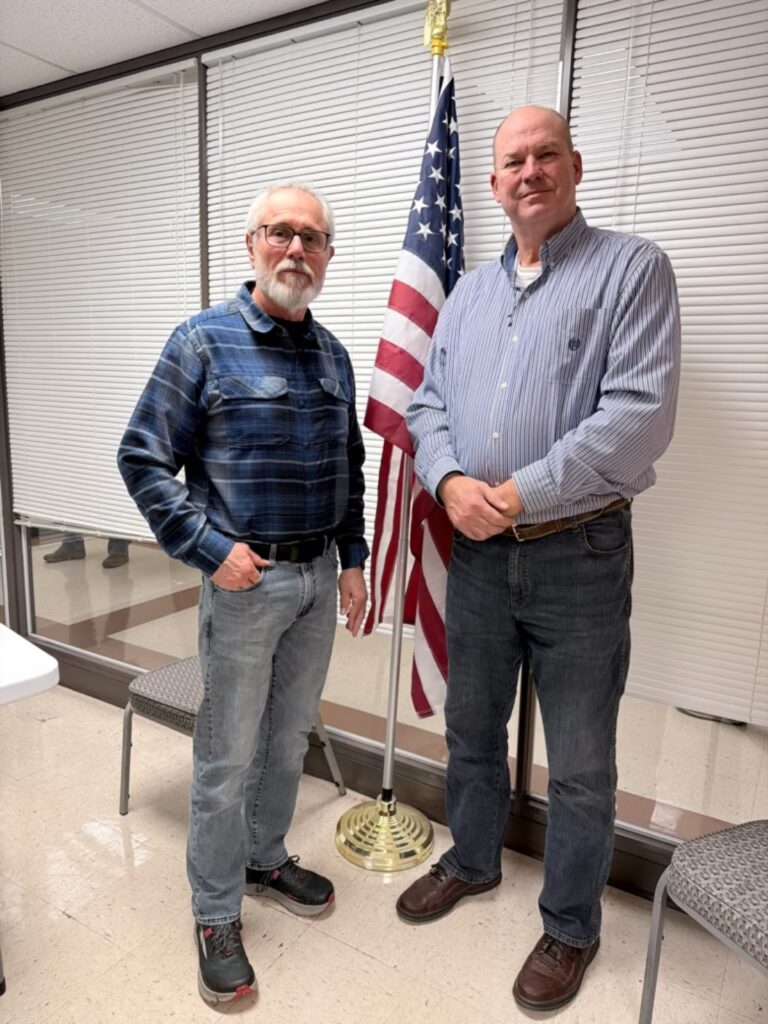
Enter Hog Control Custodian Bobby Brookshire, who has seen firsthand the damage inflicted by feral swine. After 30 years in the U.S. Army, Brookshire wanted to catch up on his hunting and fishing by returning to Blairsville, and through several contacts, was introduced to Williams and Cummings.
Following an interview and meeting other hog control custodians in Georgia, Brookshire decided to take on the responsibility full-time.
“In this county, (hog damage) would probably reach upwards of $100,000 easily,” Brookshire estimates. In his first year, he’s taken on three clients and plans to advertise his services more in the surrounding counties this year. On top of that, his goal is to educate people on what signs hogs may leave behind on their property.
One of the biggest tells is hog digs. Pigs are opportunistic omnivores – Brookshire has learned that “a hog will eat anything with a calorie in it” – and in their pursuit of grub worms, the creatures root up the ground in rivulets.
As cyclical feeders, hogs may discover crops and eat all they can before leaving and returning for another round once they learn they’ve found a reliable food source.
Although his availability is limited, Brookshire suggests calling anyway, since it’s imperative to get help as soon as the first signs are noticed. Keep in mind that the cost for Brookshire’s services is about $200 to cover expenses like gas, bait, cameras and other trapping necessities.
“When you’re competing against an animal that can have up to 72 babies per year, it’s not that we’re playing catch-up, but if we don’t try to mitigate the problem, it will continually get worse,” Brookshire warned, adding that there are so many hogs in Union County that they are “an increasing threat to agriculture and landscaping, homeowners’ acreage.”
The most effective way to deal with an infestation is to get rid of every pig in the area. Wild hogs run in herds known as “sounders.” Typically, they’re composed of a number of breeding sows with their piglets and a few boars, but any configuration can make up a singular sounder.
Brookshire monitors the property and tracks the hogs with trail cameras for as long as necessary, though the response to a single call may take up to three weeks depending on where and how the sounder moves.
Once located, Brookshire sets up net traps called “Pig Brigs,” using bait to get the animals accustomed to feeding within their confines. Once the entire sounder is in the net, the Pig Brig is shut, allowing for the immobilization and dispatch of multiple animals.
To reach Brookshire, visit https://www.gacd.us/feral-hog-control-services and click on Union or Towns County on the map to display Brookshire’s contact info.
For a more in-depth look at Georgia’s feral hog problem, consider taking the educational course at www.georgiaferalswine.com.