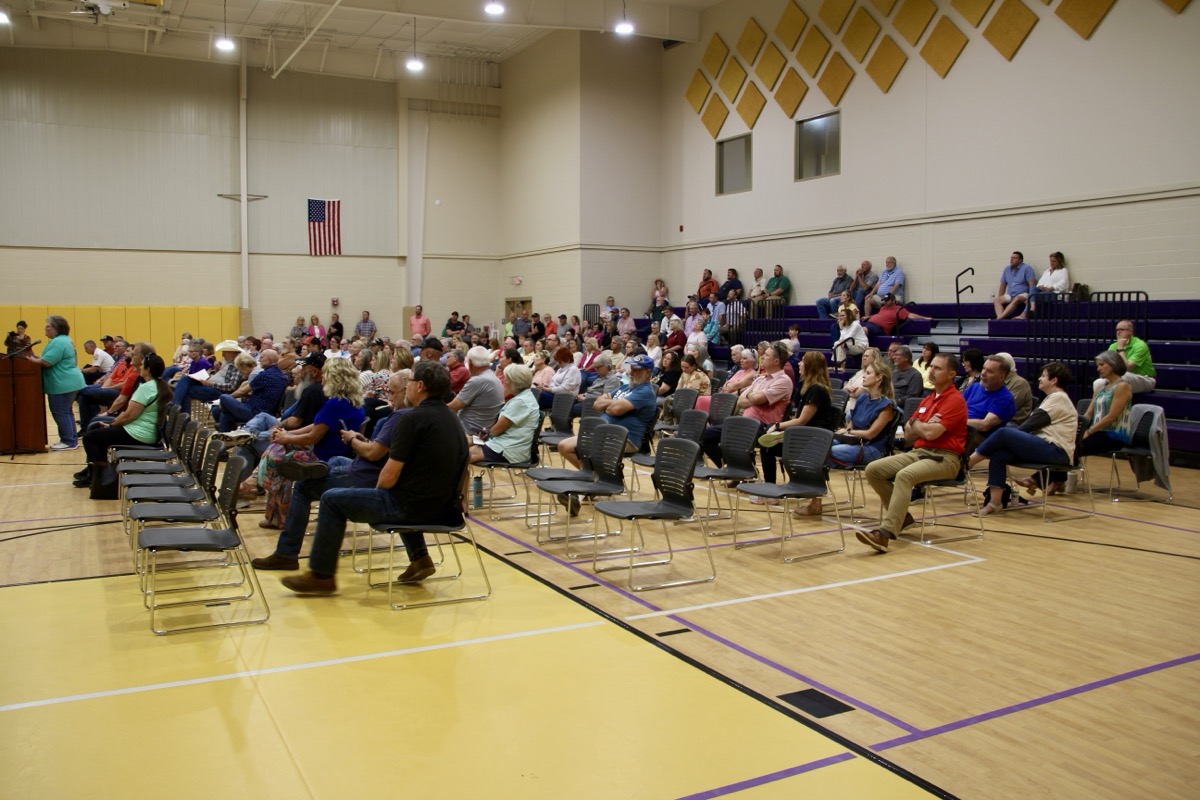
About 150 residents attended the town hall hosted by Union County Government inside the Gold Gym of the Sports Center on Tuesday, April 29.
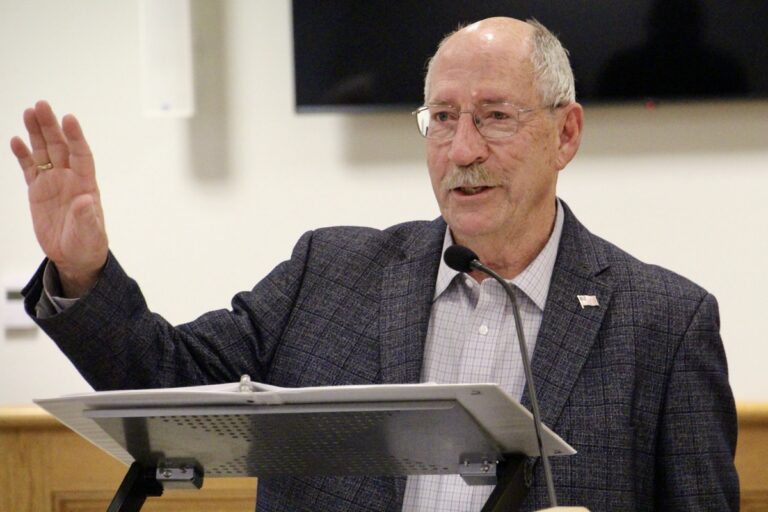
Sole Commissioner Harold Collins explained the format for the evening’s Q&A, which he had scheduled to promote transparency in local government and solicit feedback from the public.
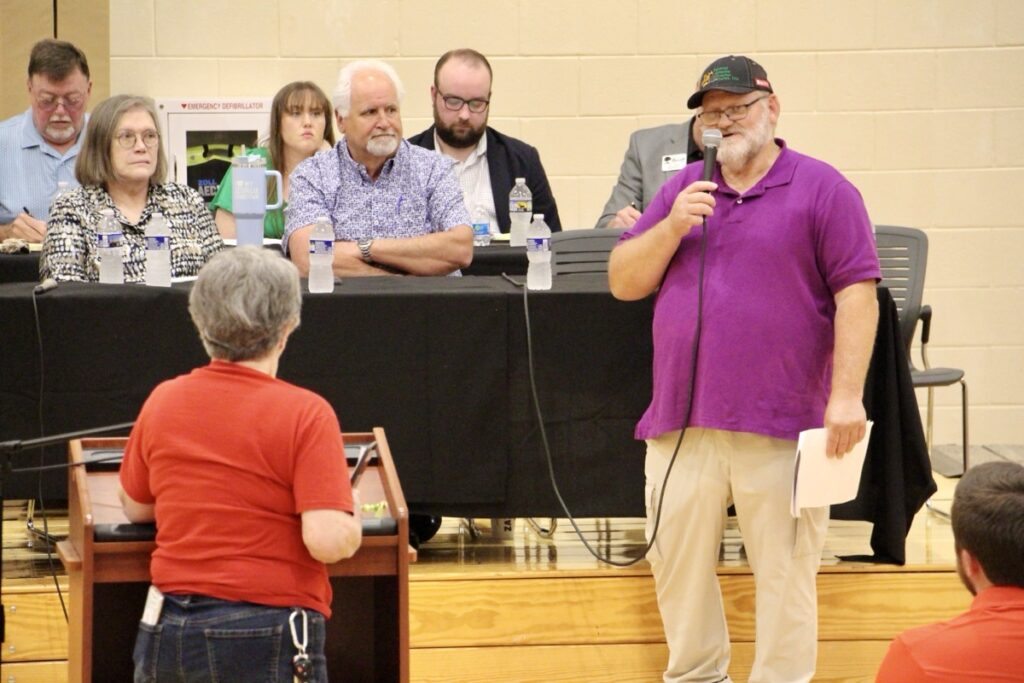
Sitting at tables positioned on a platform facing the audience were various county and city officials as well as third parties with working knowledge of the county’s governmental affairs.
Throughout the roughly two and a half hour meeting, Collins introduced several topics of discussion regarding different areas of governance, outlining his vision for each, and the officials on stage helped answer questions posed by attendees from a podium at the front of the audience.
Collins asked all to be respectful in asking and answering questions, and he requested guests keep their remarks to three minutes apiece out of respect for everyone’s time, though he did not enforce a time limit, so attendees who wanted to speak got to say their piece.
“Tonight’s meeting is not about me – it’s about y’all, the taxpayers of Union County,” Collins said in driving home the reason behind the gathering. “We’re here to listen to y’all, to get input on several different things.”
WORKFORCE HOUSING
The first topic Collins raised was affordable workforce housing, which has long been a need in the county and beyond. First responders, teachers, hospital workers and local industry personnel, to name a few professions, would be the primary targets of affordable housing initiatives.
Collins has established a multi-member volunteer committee to explore the issue and conduct surveys in the community, with early research indicating affordable as being in the range of $250,000-$350,000, though this is subject to change pending additional research.
He will continue the efforts started last year when Union County Government and the City of Blairsville went through the process of joining the Georgia Initiative for Community Housing program to better enable the county to study and plan for affordable housing.
The commissioner was asked about his campaign idea to impose impact fees on new development, and he said he would be studying the issue over potentially two years to determine if offsetting the effects of new development on county services would best be served by impact fees.
There will be no action on impact fees until his office has finished studying their use, and his early thinking is that impact fees, if imposed, might only be levied against the development of very large homes of more than 5,000 square feet.
He clarified that affordable housing should not be confused with Section 8 low-income housing, and he said the county would be looking into both homes and rentals that fall under affordable housing criteria as well as examining the balance of short-term versus long-term rentals.
Asked if he would consider touring “affordable housing” in other communities, which the questioner said usually trended toward decline, he said his volunteer affordable housing committee would be doing just that.
GROWTH
Addressing growth, Collins said he was not planning to stop it but was very much interested in managing growth and perhaps slowing it down.
“The growth is coming, and the best we can do as leadership and citizens is to plan for any coming growth,” Collins said. “Planning should include everyone in the community, or at least people from all different walks of life.
“Planning for this growth and what we see in our community as the future should not just be unmanaged building, development and businesses that don’t fit what everyone wants in Blairsville to be.”
Collins called for a “common ground” between people who don’t want any growth and those who desire “off the charts, unhinged growth” that becomes burdensome on local resources.
“While I am and have been looking for ways to decrease the budget, I am not looking at doing anything that will adversely impact local businesses,” Collins said.
One attendee said she appreciates Collins’ approach to growth, commenting that the county has seen an influx in traffic and many changes in the last few decades that have made her concerned about the potential for increased crime in a county this size.
DEVELOPMENT AUTHORITY
Broaching the subject of the Union County Development Authority, which he dissolved in February, Collins said a new authority should be formed this month, to be comprised of an expanded board that is “more diverse” – and without an executive director, at least to start.
“My goals currently for this board are to focus mainly on manufacturing industries that will bring potential skill-based careers to Union County, along with higher wage jobs,” Collins said. “I have no plans at all to anything that will negatively impact tourism.
“I realize that tourism is basically the bread and butter of our community. Sales tax is the fairest form of tax, and if we can do something to increase sales and sales tax, I am all for that.”
Responding to questions, Collins said the new board will have to report its business to him, with member recusal from decisions involving conflicts of interest, and he will be considering term limits for the volunteer board members whom he will be hand-picking.
SPLOST
Turning to the voter-approved sales tax, Collins said there were several SPLOST-funded projects currently in progress: the new 911 Center on Shoe Factory Road, the hospital roundabout, road paving, Canada Creek Bridge replacement in Suches and the Byers Road emergency exit.
The $3.8 million 911 Center was set to begin construction May 5, to take about a year to complete, said SPLOST Project Manager Kevin Hamby, who sat on the panel. The county will use $1.3 million in American Rescue Plan Act funds to outfit the building with new equipment.
A question arose about the construction of a new jail, and County Purchasing Agent Pam Hawkins said a new jail would likely require an entire SPLOST of its own, which has not yet been proposed or voted on, and there are no plans to build one at this time, though the county does own property for a future jail site.
It came out in the meeting that SPLOST will be up for renewal by voters in May of 2026.
BUSINESS LICENSES
The commissioner floated an idea of expanding business licenses in the county, which Union County Government currently only requires for short-term rentals. He said a business owner had complained he was losing out on deals because he could not provide a county business license.
Collins said revenue from implementing business licenses countywide could, for example, go toward assisting the struggling Union County Senior Center or reducing property taxes, and that the license fee would not have to be high to benefit the county financially.
Tax Commissioner Lee Knight, a panel member, said a license requirement could enable the county to hold businesses accountable to their intended land use as well as take a more accurate inventory of taxable equipment used by businesses to potentially lower property taxes.
Kurt Tangel of Georgia Mass Appraisal Solutions & Services, who works with the Tax Assessor’s Office, said business licenses would help new businesses conduct market research into the history of what businesses have been here and whether they failed or succeeded.
Several attendees spoke out against such a requirement, which they felt would be a financial burden on local business owners who already must register with the state. Collins said nothing was set in stone and he was just seeking feedback at this time.
SENIOR CENTER
Transitioning to a hot topic, Collins highlighted the turmoil experienced this year by the Senior Center, which has had to take austerity measures after expanding its meal program in recent years following an influx of COVID stimulus funds that have now been exhausted.
Donations have decreased as well, so the funding challenges have caused the Senior Center, under the management of nonprofit Legacy Link, to have to scale back some of its meal services to manage costs.
“Currently, Union County Government provides Legacy Link with a building known as the Union County Senior Center,” Collins said. “It provides maintenance at all the buildings at approximately $60,000 annually.
“It provides $109,000 towards salaries. And it has recently obtained additional property from North Georgia Technical College for expanding the center’s parking lot. This parking expansion was a direct request of center attendees.”
Collins said it takes about $545,000 to run the Senior Center “above and beyond” the facility costs, with federal and state contributions coming in at roughly $192,000.
“When you subtract the federal and state contributions, it takes approximately $353,000 to run the center based on 2024 numbers,” Collins said. “In 2024, the center raised $28,493 in attendee donations and $22,000 in outside donations.
“Normally, the center maintains a reserve to cover unexpected costs, but the Union County facility does not have the normal reserve due to the purchase of an additional van for the Meals on Wheels program.”
As noted above, the lack of funds this year has resulted in the meal program being trimmed, with a need-based scoring system being implemented to direct funding to those who need it most and fewer meals being offered each week.
“There has been some discussion of the county making up the difference, and there has been some discussion of leaving things as they are for the time being,” Collins said, asking for feedback. “I do know that a new manager was hired, and her first day on the job was yesterday.”
Several residents expressed their belief that the county could and should do more to provide for the many local seniors who rely on the center for food, socialization, exercise and more, with a general sentiment being that coming up with assistance options was a county responsibility.
Collins said he wants to be careful doling out taxpayer dollars, especially to an outside organization, and he suggested his office could help with community-based fundraisers to fill some of the funding gap while encouraging residents to make donations.
SORGHUM FESTIVAL
The commissioner once more discussed plans to host a sorghum-centric festival after the longstanding Blairsville Sorghum Festival was “permanently shut down” by organizers earlier this year.
Collins announced a new nonprofit run by volunteers who will be coordinating with other groups to host the Sorghum in the Mountains Festival at Meeks Park the usual second and third weekends in October, with proceeds to go “back into the community” where need is determined.
He said the new festival’s first year would require the county to pitch in “startup costs” from hotel-motel tax revenues, but that this money would eventually be reimbursed by the festival.
Chamber President Steve Rowe clarified that the re-branded tradition will be staying essentially the same to honor the agricultural heritage of both the festival and the area, noting that vendor fees and admission pricing will remain unchanged.
COUNTY BUDGET
County Finance Director Kay Wilcox announced Collins’ plan to implement “zero-based” budgeting starting with the 2026 Budget, to require each department to budget from zero each fiscal year to ensure that all costs are justified and not just carried over from the last budget.
Wilcox also detailed plans for what she referred to as a transparency-minded “priority-based budget,” saying that public feedback on this new style of budgeting would be solicited via multiple future surveys.
“We are going to get input from the citizens to determine what your priorities are, whether it be public safety, housing, (recreation) – any of the services that are provided,” Wilcox said. “And then our job in finance and the department heads and elected officials is to align our budget with your priorities.
“This is going to be a two or three-year process to be able to perfect the overall priority-based budget and to get where we need to be, but we are going to do that beginning now as we prepare for the 2026 Budget.”
A resident asked if the county would give a line-item account of each department to better inform the public about what they might want to prioritize, and while Wilcox said the county could do that, she emphasized that the Commissioner’s Office was not wanting “to sell the community on particular priorities” but get honest feedback without influencing folks in the process.
FINAL COMMENTS
The Union County School Board did not have a participant in the town hall, but Board Member Jason McCarter attended as a member of the public and ended up addressing those gathered as “a concerned citizen that happens to serve on the School Board.”
McCarter responded to a few attendee comments, explaining first that the board did not join the panel because no single member speaks for the group and that three or more members in the same room legally constitutes a quorum, which they only make for School Board meetings.
He wanted to clarify three things he had heard about the schools that evening, starting with the fact that the only reason school taxes make up two-thirds of property tax bills is because the county benefits from a Local Option Sales Tax that provides a rollback to lower property taxes.
Regarding the roughly $38 million in school reserves, he said that money had built up in recent years from federal COVID funds, plus the 2023 partial rollback property tax increase to offset a mandatory health care hike, but those reserves should be spent down some in the coming years.
Responding to an attendee mentioning a $1 million lawsuit against the schools, McCarter said the board “can’t comment on lawsuits.”
“Attorneys tell us not to,” McCarter continued. “That’s not what you do, that’s not a professional way of handling something … we’re going to go through the process. It’s public record, just like any complaint.”
The last public commenter thanked the commissioner and people on the panel for hosting the meeting, adding that, with all the change he has seen as a lifelong resident, “we still have a wonderful community that everyone, seemingly, wants to come to and live in,” and he encouraged all present to “continue to find ways to live and work together.”
Before closing the meeting, Collins called on Sheriff Shawn Dyer and Fire Chief/EMA/911 Director David Dyer to offer reports on their respective agencies. They indicated that the county is as busy as ever but that first responders remain hard at work protecting lives and properties.
Overall, the event appeared to be a big success. Plenty of passion was on display, with many opinions being offered and questions being asked and answered, but no exchanges got heated, and a grateful Collins said he plans to host additional town halls in the future.