The topic of Special Purpose Local Option Sales Tax featured prominently in Union County Sole Commissioner Harold Collins’ county meeting on Feb. 19, with a county-led presentation, a lengthy Q&A session, and an announcement regarding SPLOST’s return to ballots this year.
Collins said his planned SPLOST continuation vote would be delayed until November. He wanted voters to decide SPLOST VI in the May General Primary Election; however, he is having to postpone the vote due to the Elections Board missing a legal publication deadline.
In the public Q&A, it came out that Collins would not be putting the Floating Local Option Sales Tax up for another vote this year after it failed last November.
Collins was interested in pursuing another FLOST vote this November, but since SPLOST is the bigger priority, he has decided not to hold another FLOST referendum in 2026.
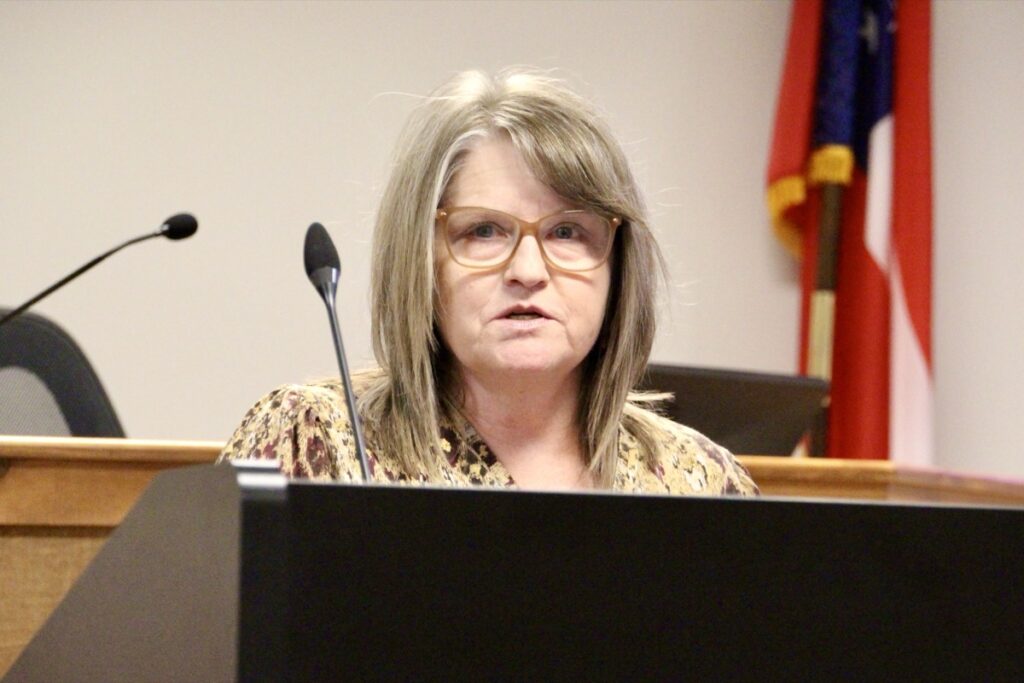
As SPLOST was broached multiple times in the January county meeting, Collins used his February meeting as an opportunity to have County SPLOST Program Manager Pam Hawkins explain some of the financial breakdown related to the current SPLOST V.
Hawkins prepared a slideshow with key pieces of information about SPLOST V as of Dec. 31, 2025, including the original estimated revenue of $24 million that appeared on the SPLOST referendum, as well as the revised estimated revenue – actual and projected – of $45 million.
She said the original estimated revenue was calculated based on SPLOST IV collections, and that SPLOST V has been overperforming the initial estimate, which has enabled both county and city governments to put more SPLOST dollars toward voter-approved project categories.
By contrast, she harkened back to SPLOST III, which underperformed with a little over half of original projected revenues coming in due to the economic downturn to start the 2010s, pointing out that initial SPLOST estimates are pretty much guaranteed to fluctuate – sometimes by a lot.
SPLOST V has about 15 months left to collect its full six-year term, and even though the revised collections are more than $20 million over the original projection, that does not mean the county has $20 million in extra money sitting around.
By the end of 2026, the county will have spent $5 million on public safety upgrades like the new 911 Center construction and technology, Fire Department equipment and Sheriff’s Office vehicles, as well as $4.3 million on road/bridgework, plus additional SPLOST expenditures.
Barring other SPLOST-eligible needs arising this year – needs as determined by the Commissioner’s Office in coordination with county department heads and elected officials – the county should have about $6.4 million in available SPLOST proceeds to start 2027.
About two dozen residents attended the meeting, with a few asking questions related to SPLOST.
The county attempted to clear up confusion as to why so much money is being projected now compared with the original estimate, and then, how the county has been deciding what projects to spend SPLOST dollars on so far beyond the initial collection estimates.
County Attorney William Mercer explained that the county can collect and spend SPLOST dollars past the original estimates if it has an intergovernmental agreement with the City of Blairsville – which it does.
And Hawkins said that the voter-approved project categories contain percentages that help guide the county in determining which projects to approve moving forward. She also said specific needs are hard or impossible to predict years in advance, which is why SPLOST referendums usually contain project categories.
Bottom line, Hawkins said that new expenditures are always going to come, and that the county would rather spend SPLOST funds on eligible projects than hit up property taxpayers, because sales taxes are paid by everyone in Union County, residents and visitors alike.
One resident perceived a conflict in the commissioner calling for increased property taxes if SPLOST VI does not pass this year, and the fact that SPLOST V collections are so much higher than initial projections – so why not use that surplus to prevent tax increases.
Collins said declining to use available SPLOST money would not keep roads and infrastructure from needing to be fixed; the county would just have to borrow money or increase property taxes, because road maintenance and other SPLOST priorities are “never-ending,” he said.
Another resident, in pursuit of providing voters with a chance to make “rational decisions,” asked about a SPLOST VI Town Hall, which Collins said would be coming up later this year before the General Election.
The same resident asked that, before voting takes place, the county make available to the public a “full accounting of SPLOST V from its inception to date, showing the actual expenditures for the actual projects that have been funded by SPLOST V.” Hawkins agreed.
Next month’s county meeting has been moved from March 17 to March 24 to accommodate a scheduling conflict. The meeting will still take place at 6 p.m. inside the Union County Courthouse.