On Thursday, June 11, the Union County Commissioner’s Office welcomed more than 400 people to the Multipurpose Gym at the Sports Center for a public hearing on revisions to the local ordinance regarding “data centers.”
It was the largest county meeting anyone could remember and lasted about 2.5 hours, potentially another record.
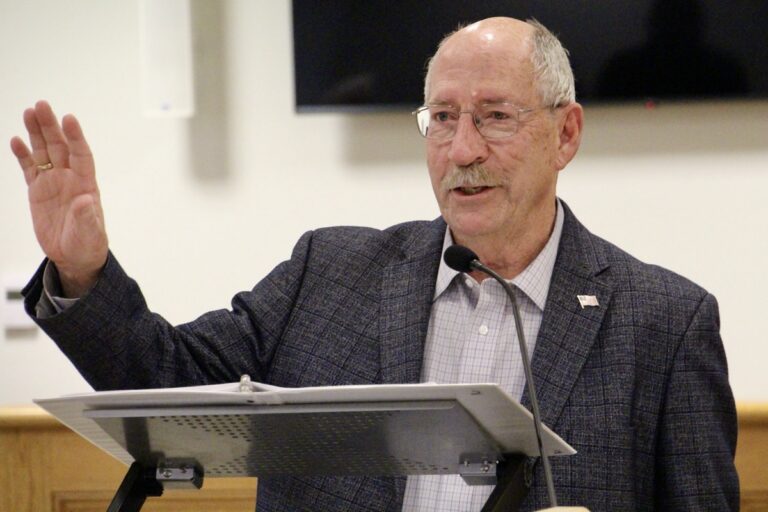
The occasion was a rare showing of public solidarity across the political spectrum; seemingly everyone in attendance – from well-known local Democrats and Republicans to Sole Commissioner Harold Collins himself – offered a resounding “NO!” to such facilities.
To set the stage for the public hearing, Collins held a May 21 first reading of proposed revisions to the county’s already existing ordinance, which has governed activity involving “Cryptocurrency and Data Mining” since 2023.
As with the initial creation of local regulations, the current revisions are in response to the strong desire of residents and local leaders to restrict data centers due to their many negative impacts, including to the environment, public utilities, human and wildlife health, quality of life, etc.
Communities around the nation, and even right across the state line in Cherokee County, North Carolina, are now home to unwanted data centers because they did not have the necessary legal requirements to control their development.
Union County got ahead of the curve by putting protections in place several years ago, and Collins is enhancing those protections now because, while no developer has approached the county to date, many people believe it is just a matter of time before someone tries to bring a data center here.
Based on public feedback received between May 21 and the week of June 11, the draft of revisions more than doubled, growing from four to nine pages and resulting in a much more robust version of the revised ordinance being presented last Thursday.
Collins, who was pleased with the level of public participation, opened the hearing by expressing his hope that “100%” of the people in attendance were “against data centers,” prompting the assembled crowd to erupt in cheers.
Truly, everyone was on the same page, with not a single person coming forward in favor of data centers, either in person, over the phone or via email since the revision process started.
In preparation for the hearing, the Commissioner’s Office received dozens of emailed comments and helpful suggestions on how to strengthen local regulations, many of which were directly incorporated into the proposed revisions detailed in last week’s meeting.
According to the county, the goal of the current process is to increase protections against the local establishment of “Digital Infrastructure Hubs,” which is the revised catchall term meant to accommodate a larger swath of unwanted facilities.
Digital infrastructure hubs account for things like data centers, crypto mining operations, server farms, cloud computing, specialized AI data centers and more, all addressed in the revised ordinance.
Essentially, the county is hoping to put enough regulations in place that Union County becomes an extremely unattractive development environment – restrictive enough to encourage would-be data center developers to look elsewhere.
Many of the comments the county has fielded include requests to outright ban the development of data centers; however, County Attorney William Mercer said in the hearing that doing so may put the county in civil jeopardy that comes with a risk Collins is unwilling accept.
If the county were to ban them altogether and a major company with plenty of financial resources were to sue over the ban, Mercer said the county could lose a court battle over the issue, which would potentially mean data centers could set up shop here with zero restrictions.
That has left the county with only one good option in Collins’ mind: strengthening the existing ordinance. However, Mercer said the revisions must thread a fine line, because regulations could also be defeated in court if they are so strict as to effectively result in a ban.
As noted above, the draft presented in the public hearing was a considerably beefed-up version of the ordinance, and it took Mercer nearly 30 minutes – with a few interruptions from restless members of the crowd – to read aloud the document.
Perhaps the biggest point of contention that evening was whether Mercer should read the entire ordinance, with some people asking to skip it.
But Mercer – and most attendees – wanted to continue with the reading to inform everyone about the changes the public was seeing for the first time that Thursday so as to better prepare people to comment during the hearing.
Under the existing ordinance, crypto and data-mining developers must adhere to exact sound level requirements and testing to ensure their noise is contained to a specified geographic reach, with other protections for emissions, cybersecurity, construction requirements, etc.
All that is still in there, but the revisions greatly improve existing protections and are too many to include with this report. However, one new standard that stands out is the creation of a public hearing process prior to the issuance of permits by the Union County Building Department.
This permitting requirement calls for a public hearing to be scheduled to give people a chance to provide feedback; all property owners sharing property lines with the proposed site to sign agreement with the facility’s construction; written notification to every resident in a three-mile radius of the site made within 14 days of the public hearing; the completion of environmental, cultural heritage, and Native American-led impact evaluations; and more.
Additionally, the proposed revisions include provisions concerning power and water, though Mercer said the county lacks the authority to regulate amounts used because it does not own any local utilities.
Wastewater disposal, construction traffic, fire suppression, ground-to-air transmission vibrations, and decommissioning bond requirements are also accounted for in the new draft, among other items.
One new requirement that remained between the May 21 and June 11 drafts: development can only occur on properties containing at least 500 acres of continuous acreage.
Mercer said the Commissioner’s Office could only find two parcels in the county large enough to meet that requirement, but even then, the acreage minimum is just a single requirement in a lengthy list of other regulations that would have to be met.
A particularly well-received announcement was Collins’ intent to adopt a resolution setting the permit fee at 25% of total construction costs, with the example given that a $1 billion facility would require a $250 million permit fee.
Enforcement of the ordinance consists of violations adding to a maximum penalty of up to $1,000 in fines, imprisonment for 60 days, or both, with each day in violation considered a new violation.
Just over two dozen public hearing attendees offered comments and suggestions to make regulations even stronger. Collins received many thanks for his determination to make it harder for data centers to be built here, but most of the commenters believed he could go even further.
Some new suggestions offered that evening included upping the 500-acre minimum, mandating closed-loop cooling systems, specifying vague language around testing and evaluations, enhancing health and security guidelines, requiring solar power, introducing zoning, increasing fire protection, requiring a contamination correction plan, guarding against annexation to get around the ordinance, and others.
Many of the ideas offered, including those by residents who have professional experience with data centers, are sure to be included in the next draft, which will be presented as a second reading at an upcoming county meeting.
After the second reading, Collins will give the public time to digest the new changes and provide even more suggestions before he finally enacts an update to the ordinance. In the meantime, the county is all ears for additional comments and concerns.
Importantly, there’s still a moratorium in place preventing the development of these facilities, set to run through mid-August. The Commissioner’s Office will extend the moratorium if needed to continue working on the ordinance. The moratorium will end when the ordinance is enacted.
A note on the public hearing venue:
Due to outstanding attendance, seating was limited inside the gym. County employees brought in chairs when it became clear the bleachers would fill up, but there weren’t enough chairs, either. So, people ended up sitting on the floor or standing along the walls, which was especially displeasing to some older residents.
Anticipating a large crowd, the county had printed 300 copies of the revised draft to give to guests, but the copies ran out; for the better part of an hour before the hearing, the line stretched through another gym and into the Sports Center lobby, at one point going out the front door.
The Commissioner’s Office expected a lot of people to show; online interest in the hearing spiked the week before the scheduled hearing, and the county knew the usual venue inside the Union County Courthouse would not have enough space to fit attendees.
That’s why the county switched the hearing location to the Multipurpose Gym, but not before attempting to secure a much larger venue, the Union County Schools Fine Arts Center. Unfortunately, the Fine Arts Center was already booked for June 11, according to the county.
Another common complaint about the gym was that it was difficult or impossible to hear what was being said, again, particularly for the older residents in attendance, as the sound system setup caused reverberation from the poor acoustics of the venue.