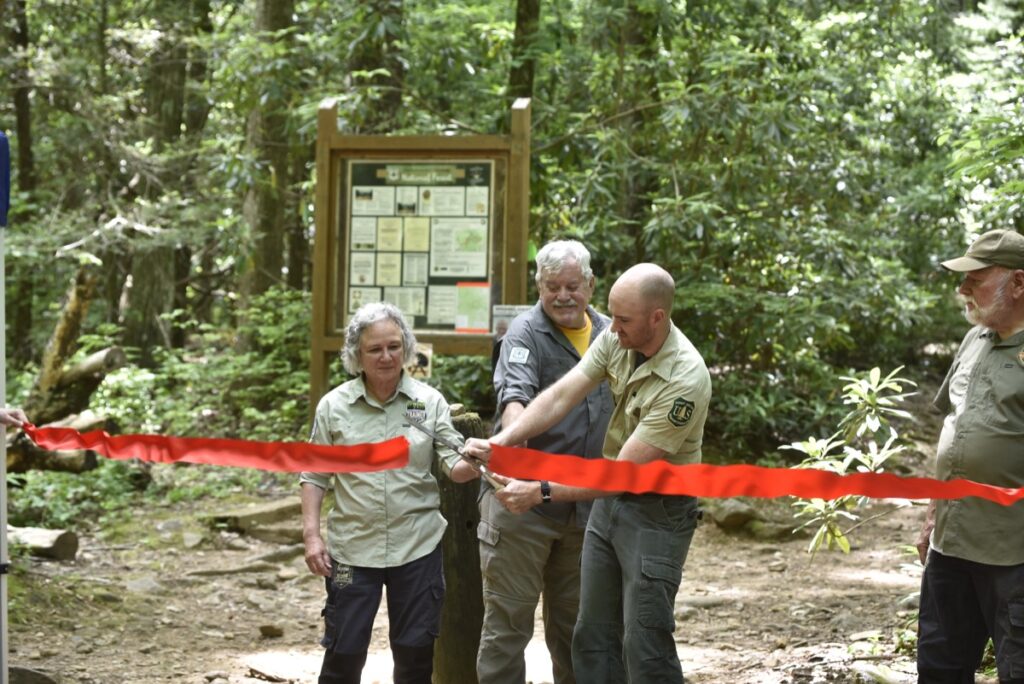
The U.S. Forest Service, in partnership with the Appalachian Trail Conservancy and the Georgia Appalachian Trail Club, has completed a reroute of the Byron Herbert Reece Trail, so named years ago for the beloved poet, farmer and native son of Union County.
Stakeholders celebrated the occasion with a public ribbon-cutting ceremony held on Saturday, June 6, at the trailhead on Blood Mountain in the Chattahoochee-Oconee National Forest, just north of Neel’s Gap off the Gainesville Highway.
The project created approximately 1.4 miles of new trail connecting the Byron Herbert Reece Trailhead Parking Lot to the Appalachian Trail near Flatrock Gap, with the former 0.8-mile trail to be closed and allowed to return to a natural condition.
Designed to better meet federal wilderness guidelines while providing a more sustainable long-term hiking experience, the new trail replaces portions of the previous route, which had become wide, heavily eroded and difficult to follow due to numerous user-created paths.
Modern, sustainable trail-building standards were utilized to give the new route a narrower tread, fewer constructed features and a more natural backcountry experience.
According to GATC Board President Ashley Luke, the project has been in the works for nearly 10 years to correct issues with the original trail, which was built long before modern trail-building techniques were widely understood.
“When it rains, the water runs straight down it, so it’s gotten really wide and eroded,” she said. “We’ve had to install over 100 rock steps, and it makes it feel like you’re on a man-created trail.”
Blood Mountain and the Byron Herbert Reece Trail are located within a federally designated wilderness area, where Congress has directed land managers to preserve natural conditions and opportunities for solitude and self-reliance.
Trails in wilderness areas are intentionally narrow, minimally developed and maintained using hand tools.
“Our goal was to create a trail that was more in line with the wilderness character, that takes you meandering through the woods with less man-made structures and gives you more of a connection to nature,” Luke reiterated. “At the same time, it’s built to better standards that will prevent erosion.”
Visitors are encouraged to plan ahead and carry appropriate gear, water and navigation tools when traveling in wilderness areas. And people used to the old trail should familiarize themselves with the new one.
“Hikers using the old trail would arrive at the A.T. opposite the Freeman Trail and frequently made a loop using the A.T. and Freeman Trail,” according to the GATC. “Hikers need to be aware that the new Byron Herbert Reece Trail now arrives at the A.T. about a quarter mile west (trail-south) of the Freeman.”
Importantly, signage will be posted at critical areas to assist hikers in finding their way, and GATC volunteers will also be patrolling the area as they are available to assist hikers, the group said.
As noted above, the project is the result of a partnership among the U.S. Forest Service, Appalachian Trail Conservancy, Georgia Appalachian Trail Club and numerous volunteers whose efforts helped make the trail relocation possible.
During the ribbon-cutting ceremony, the GATC honored 45-year member Marion McLean in recognition of his hard work and dedication to preserving North Georgia’s hiking trails since 1981.
Anyone interested in volunteering or becoming a member of the GATC can learn more at georgia-atclub.org.