After spending 40 days setting political priorities and haggling over the particulars, Georgia General Assembly lawmakers ended the first leg of their 2025-2026 Legislative Session on Friday, April 4.
As usual, the Blairsville-Union County Chamber of Commerce invited the state legislators representing Union County to brief chamber members on Gold Dome business, welcoming them to a special entry of the semiregular “Eggs & Issues” guest speaker program.
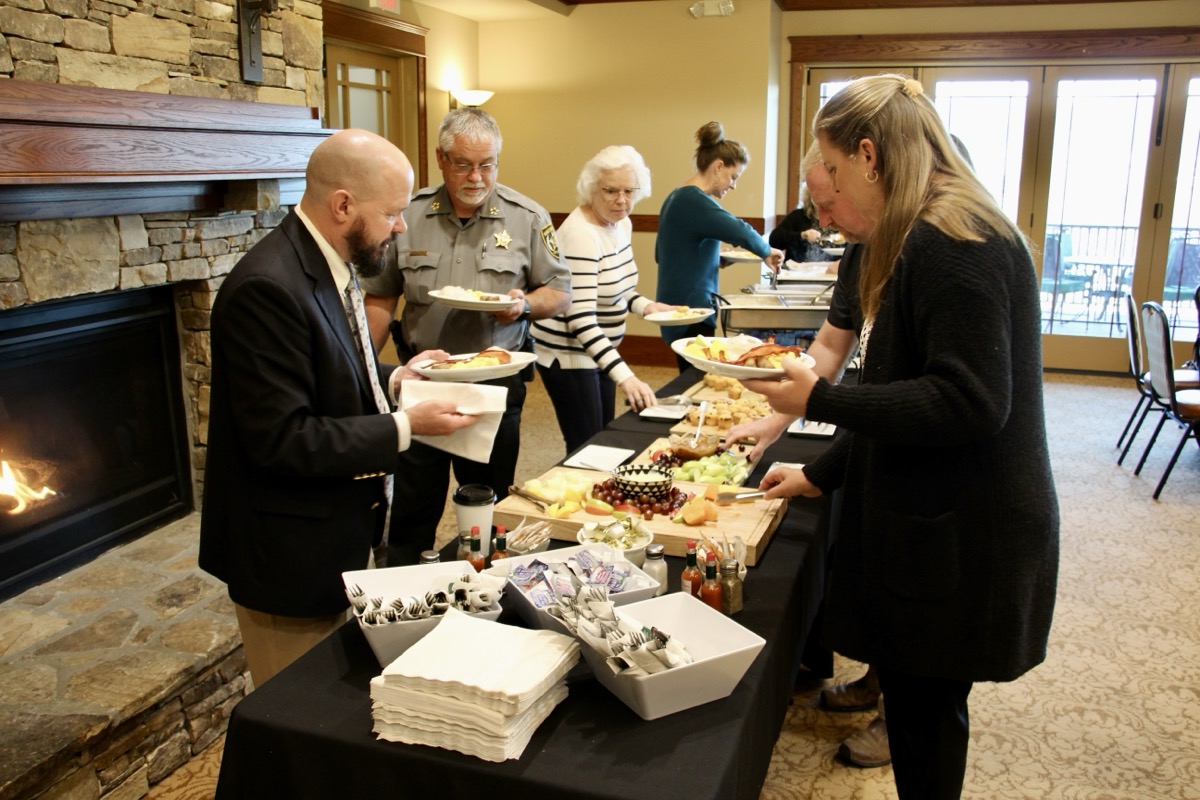
Billed as a “Legislative Wrap-Up,” District 51 State Sen. Steve Gooch and District 8 State Rep. Stan Gunter joined a roomful of chamber members for a breakfast buffet provided by The View Grill inside the Union County Community Center on Wednesday, April 16.
Gunter serves constituents in Rabun, Towns and Union counties and portions of White County, and Gooch represents Fannin, Union, Gilmer, Lumpkin, White, Dawson and parts of Pickens and Forsyth counties.
Sen. Gooch spoke first. The Dahlonega-based lawmaker has served in Georgia Senate leadership for over a decade, having risen to Majority Leader in 2022, which benefits all North Georgia citizens by elevating their concerns in state politics.
Last Wednesday, Gooch delved into a range of issues raised and passed in this year’s legislative session.
He started off with a financial discussion, lauding the state’s requirement that lawmakers must adopt a balanced budget, as opposed to the federal government.
Further, Gooch noted he was proud “that Georgia has a real conservative budgeting policy” that is informed by Gov. Brian Kemp’s office and state economists who account for state, national and global indicators across a multiplicity of industries when setting fiscal policy.
“Right now, our state’s doing quite well,” Gooch said. “We still have positive growth. Revenues continue to increase month after month, year after year. And we have a record surplus; our surplus hit $16 billion this year, and that’s monies more than what we spend.
“So, that money is sitting in a money market account drawing interest – a pretty substantial interest rate at this time – but we’re investing that money back into the taxpayer’s pocket as well.”
Gooch mentioned attending an April 15 signing of two bills passed by the General Assembly this year, one to reduce the state income tax rate “for the third consecutive year,” and another authorizing a surplus tax rebate in the form of direct payments to all tax filers.
Worth up to $500 for married couples, the rebates have been made possible due to the budget surplus, with $1 billion going toward funding the payments that should make it into taxpayers’ hands within the next couple months.
“The tax cut is another billion or so dollars that we will not collect next year because we’ve lowered both the personal and corporate income tax rates,” Gooch said. “We’d love to eliminate Georgia’s income tax. I know all of you in the room would like to see that as well.
“Other states around us have done that – we’re not there yet. It’s going to take some time. Now, we have eliminated income taxes for seniors who are 65 and over for the first $135,000 of income.”
Also new in 2025, lawmakers created an income tax exemption on the first $65,000 in retirement money for military personnel, which Gooch believes will make Georgia more competitive from a tax standpoint to inspire veteran retirees to move to Georgia.
In addressing Georgia’s rapid population growth, Gooch said the state was investing “billions of dollars into our infrastructure,” including an extra $1 billion from the surplus to better meet transportation needs.
Speaking of infrastructure, Gooch said the ports at Savannah and Brunswick were “two of the fastest growing in the business on the Eastern Seaboard,” bringing regular growth in imports and exports for the Peach State.
“A lot of that freight is coming right up through North Georgia on our highways into other states,” Gooch said. “Interstates 85 and 75 are just covered up with tractors and trailers, and we’re trying to fix some of that with our Freight & Logistics Plan (to leverage our railways).”
Gooch also touched on recovery efforts in the wake of Hurricane Helene last September, which destroyed about $7 billion in public and private property from Augusta to Valdosta. On top federal reimbursements, the state will help offset those costs with another $1 billion in surplus.
Elsewhere in the state budget, Gooch said the Georgia Department of Corrections would be getting an extra $100 million to improve prison guard salaries, hopefully to shore up retention amid a roughly 40% vacancy rate as employees get trained up and leave for better paying jobs.
“It’s a dangerous situation,” Gooch said. “Literally, we have organized crime in our prison system. There have been studies, there have been investigations ongoing. We continue to work on that to try to fix it.”
Switching gears, Gooch turned to tort reform, that is, lawsuit reform, which is an issue the state has been trying to tackle for years and something he said was a priority for the senate this year, especially after Gov. Kemp helped spur the legislature into action.
“The problem (has been) our insurance premiums continue to skyrocket,” Gooch said, outlining how consumer costs have increased from insurance companies fleeing Georgia because they cannot make money due to the financially challenging conditions surrounding liability lawsuits.
Lawmakers passed “two significant pieces of legislation,” Senate Bill 68 and Senate Bill 69, which Gooch described as “common sense adjustments to our judicial system” aimed at striking a balance between targets of liability lawsuits and the victims bringing the lawsuits.
Sen. Gooch spoke briefly about legislative priorities regarding safety on school campuses, referencing the horrific school shooting at Barrow County in September 2024.
Legislators have passed a new law that will require “panic buttons” to be worn by all school staff members. When pressed, the buttons will place a call directly to 911 and pinpoint the location of the staff member inside a school.
About $100 million is also being appropriated to “harden” schools around the state against potential security threats, and money will be going toward mental health services for children in hopes of preventing tragedies like what happened in Winder last year.
“One last thing,” Gooch said. “This may sound ridiculous to y’all, but we believe that boys should be boys and girls should be girls, and that boys should not be competing in girls’ sports, and they sure as heck shouldn’t be in the locker rooms and in the same shower facility.”
To accomplish this, the General Assembly passed the Riley Gaines Act of 2025, which the governor is expected to sign into law.
REP. STAN GUNTER
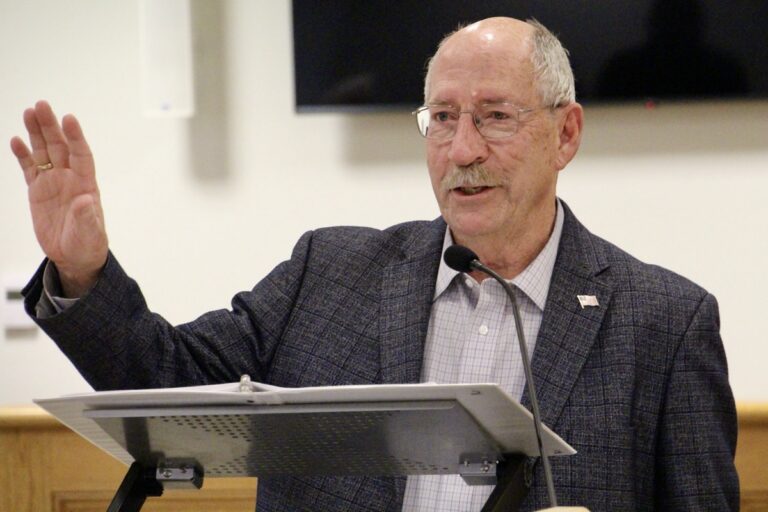
State Rep. Stan Gunter focused much of his time on House Bill 582, a piece of legislation he sponsored that will provide a legal pathway for victims of domestic abuse to offer potentially exculpatory evidence in instances where they have been arrested or imprisoned for crimes.
“Maybe they commit a murder or something less,” Gunter said, “or they’re coerced into committing another crime, and they don’t get the opportunity to present the evidence of the long-term abuse that they’ve had and the effect that it had on them.”
Known as the Georgia Survivor Justice Act, House Bill 582 allows a “defendant-victim” to introduce evidence of their abuse before the start of trial.
“They can do it by a motion in a justification hearing to justify what they did,” Gunter said. “If the judge reads that they were justified – and it has self-defense elements in it – then they would be allowed to leave and not have to face a trial.
“But those that have faced a trial and been convicted could use that evidence in mitigation to help reduce a sentence. And then we have those that are in prison right now that never got to give that evidence to a court, a judge or a jury, and so they’re stuck in prison for life, some of them.”
Importantly, Gunter said House Bill 582, which passed with strong bipartisan support and is headed for the governor’s signature, “is not a get out of jail free card.”
“It is a recognition of the abuse that they’ve gone through and a reduction in the crime,” Gunter said. “If they committed a murder, the sentence would be amended from a life sentence to (30 years, to serve 10 in prison).
“They could still get paroled if they’re able to show that evidence. Basically, they get two shots if they’re in prison: evidence that was not produced or given at trial that they have, they can present that; and later on, if any new evidence comes along, they would have one more hearing.”
Gunter read a heartfelt thank-you card from a female prisoner “who murdered her abuser,” holding up a picture of the woman and her child that was included with the card. This prisoner’s life sentence could be reduced due to the new law, and Gunter has received many similar cards.
“I’m proud of that bill, and I think it will help some folks,” Gunter said. “We’re learning more and more about domestic violence as we go along, and this will give some people a chance at a new life.”
A former prosecutor and superior court judge in the Enotah Judicial Circuit, Rep. Gunter is right at home chairing the Judiciary Committee in the state House of Representatives, where he assists in guiding the legislative priorities for Georgia’s justice system, like with HB 582.
He also discussed House Bill 92, which amends last year’s House Bill 581 to allow local governing authorities two more years to consider whether to opt out of the statewide floating homestead exemption – a process that has created considerable confusion around Georgia.
“This stuff is complicated; I don’t even understand it,” Gunter admitting, saying that the confusion led to many communities “taking the option of opting out and not using (the exemption).”
In terms of the state’s tort reform efforts, Gunter said the legislative fixes were not perfect, but he hoped they would accomplish the goals sought by proponents; if not, then “there will be some bills that will come back and tinker with the details and make it better.”
Additionally, Gunter announced the legislatively created Office of Safe Schools within the Georgia Emergency Management & Homeland Security Agency to bring additional resources to promoting best safety practices within local school systems.
He highlighted other legislative accomplishments, including banning cellphones for kindergarten through eighth grade; passing in vitro fertilization protections; prohibiting state purchases from foreign adversaries; establishing reporting requirements for postsecondary education funding from China; advancing support for Next Generation 911; revising traffic camera use in school zones to be more forgiving of drivers; expanding home health services; protecting small pharmacies; doubling the death benefit for officers killed in the line of duty; balancing salaries for state judges; enacting digital driver’s licenses; streamlining interstate transfers of professional licenses; and more.
VOTING MACHINES
A single question was posed during the Q&A portion of the event, with Patrice Kilpatrick asking what efforts were being made in Atlanta to move away from electronic voting machines and potentially back to paper ballots.
Gooch mentioned two election-related bills that will presumably be picked back up when the 2025-26 session exits recess next year: one to provide voters with a hand-marked paper ballot option; and the other to withdraw the state from the Electronic Registration Information Center.
“What we want to do in the Senate is get rid of the Dominion machines,” Sen. Gooch said. “We believe that there are still questionable issues with them. The QR codes are a concern. A lot of people have expressed their concerns for the last four years.
“Personally, I think the voters have lost confidence in that technology, and so we just want to get rid of them. The reason is, in order to upgrade the Dominion machines, the software upgrade is going to require a $77 million investment.
“We’ve already spent $130 million on the machines. Now, the Secretary of State’s requesting $77 million to do the upgrading. I’m at the point where we can go back to a standard, traditional paper ballot. Now, you might think that sounds kind of antiquated.
“Two-thirds of the people in the country that vote today vote on a paper ballot. We’re only one of two or three states that have this Dominion machine technology. I think before we dump another $75 million or $100 million into it, we need to go back to a paper ballot.
“But use the machines to count the ballots, and then you have an audit trail. You have the paper ballot in the tray. You would also have the computer tabulation. Those two numbers should be exactly the same before those ballots are taken out of that box for permanent storage.”
Added Gooch, “The other bill is to get rid of the ERIC system, (which is) simply a way to purge voters who are no longer actively voting in Georgia. The only way to know that is if you communicate with other states.
“The ERIC system has been flawed somewhat; there’s only about 26 states that are using the ERIC system. That’s the technology the Secretary of State’s Office has been using to try to track people who try to vote here and (in other states). We think there’s a better method of that as well.
“Part of that bill also takes the State Elections Board out from under the Secretary of State’s Office and puts it under an independent agency of the (State) Accounting Office. So, we think that should be out from under the Secretary of State because he’s a constitutional officer who has to run his own elections every four years as well.”
The breakfast was sponsored by United Community Bank, Union General Hospital and the Mountain Life Real Estate Team.