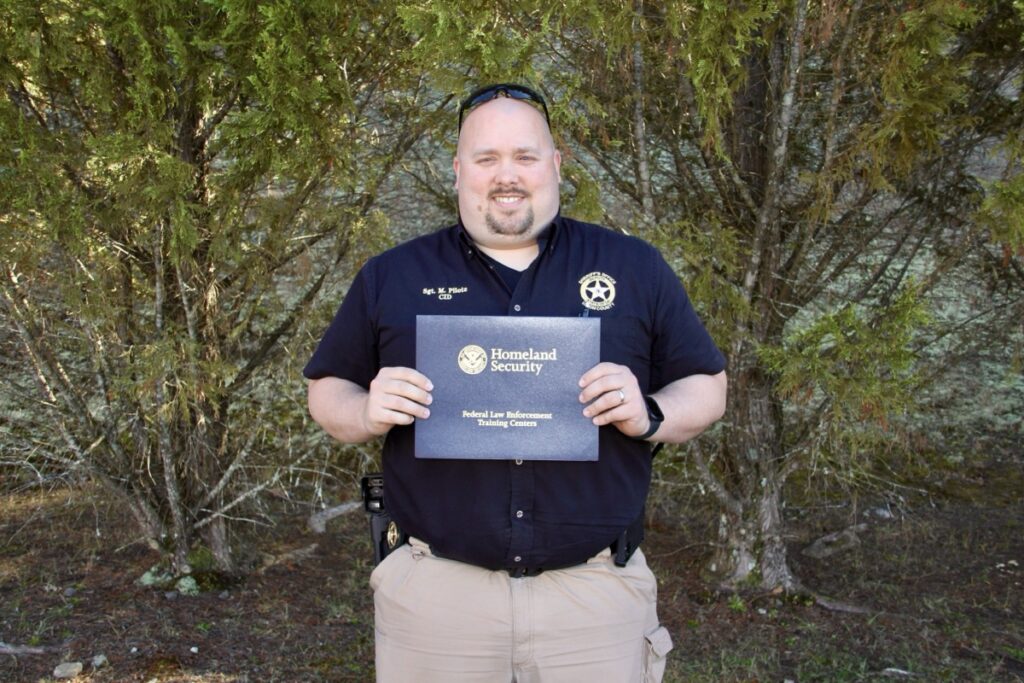
Union County Sheriff’s Sgt. Marc Pilote is now a fully certified Firearms Instructor, having just completed a specialized training program administered by the Federal Law Enforcement Training Center that is housed within the U.S. Department of Homeland Security.
Pilote is stationed within the UCSO Criminal Investigations Division, where he focuses on crimes that occur between people, like assaults, as well as Internet Crimes Against Children.
When he started his law enforcement career here in 2014, he set a 10-year personal goal of becoming an instructor to offer state-mandated and additional trainings to local deputies.
He met that goal last summer, earning his general instructor credentials through the University of North Georgia Police Academy, enabling him to teach – and even create courses to meet local needs – on topics ranging from use of force to body cameras, de-escalation and crime scene management.
And last month, Pilote furthered his goal by graduating from the Firearms Instructor Training Program – an advanced level of training required to expand the type of instruction he can give at the Sheriff’s Office.
Pilote traveled to the federal training facility in Charleston, South Carolina, to take part in the 80-hour course from Dec. 9-20. The course was extensive, featuring all theoretical and practical aspects of training other law enforcement officers in how to properly shoot and handle firearms.
In addition to the knowledge component, Pilote spent a lot of hands-on time with his service pistol running through various drills designed to improve skills like getting on target from the holster and general marksmanship.
He fired at least 1,000 rounds during the training, primarily from his sidearm but also from rifles and shotguns – and that’s a conservative estimate, he said.
As an official Firearms Instructor, Pilote will be working with fellow deputies to accomplish their state-mandated firearms qualifications at the Union County Gun Range.
“This now allows me to go and teach our deputies various firearm drills and techniques,” Pilote said. “If there’s any kind of remedial training needed, I’ve been trained in various ways to help diagnose shooting problems and how to fix them.”
No matter their experience level, all UCSO deputies have at least the basic level of training through their initial state certification, but being able to shoot quickly as well as accurately under pressure is something that requires regular practice, hence the annual qualification.
“Shooting is kind of like riding a bicycle because it is a fine motor skill,” Pilote said. “But there is a diminishing return in that, if you don’t practice, you lose proficiency in it. So, there is an importance of maintaining that proficiency level, and that’s part of the qualification.”
The Sheriff’s Office treats all training seriously; it must, because the nature of each deputy’s job involves the inherent risk of life and death situations occurring at any given moment.
And if that wasn’t enough, there’s also the issue of liability from being inadequately trained, which can lead to innocent bystanders being injured, otherwise solid cases becoming compromised, the potential for lawsuits, and any number of other bad law enforcement outcomes.
Of course, Pilote will be striving to prevent such outcomes with ongoing training throughout each year alongside lead instructor Lt. Dustin Walker, who took over UCSO training after former instructor Craig Davenport retired last year to run the Union County Gun Range.
Training deputies in-house is a great way to save taxpayers money, as typically, training elsewhere – even in-state – requires counties to cover for food and lodging for traveling deputies, which is in addition to their pay and fuel costs to get wherever they’re going and back.
But not all out-of-county training requires a significant expenditure. Pilote’s instruction at the Federal Law Enforcement Training Center, or FLETC, is a great example of how the Sheriff’s Office is always seeking out opportunities to maximize its outcomes at the least cost.
Aside from Pilote’s salary and gas for travel, the federal program covered all expenses to train him as a Firearms Instructor – a savings to the Sheriff’s Office in the thousands of dollars. FLETC even provided firearms and the massive amount of ammunition used.
“We’re really wanting to excel in bringing phenomenal training here, so we’re investing in our instructors – both me and Lt. Walker – to be able to do that,” Pilote said. “And that will save money from having to go elsewhere if we can host higher-level training in Union County.”
Moving forward, Pilote plans to continue his training as an instructor to provide even more training at the Sheriff’s Office.