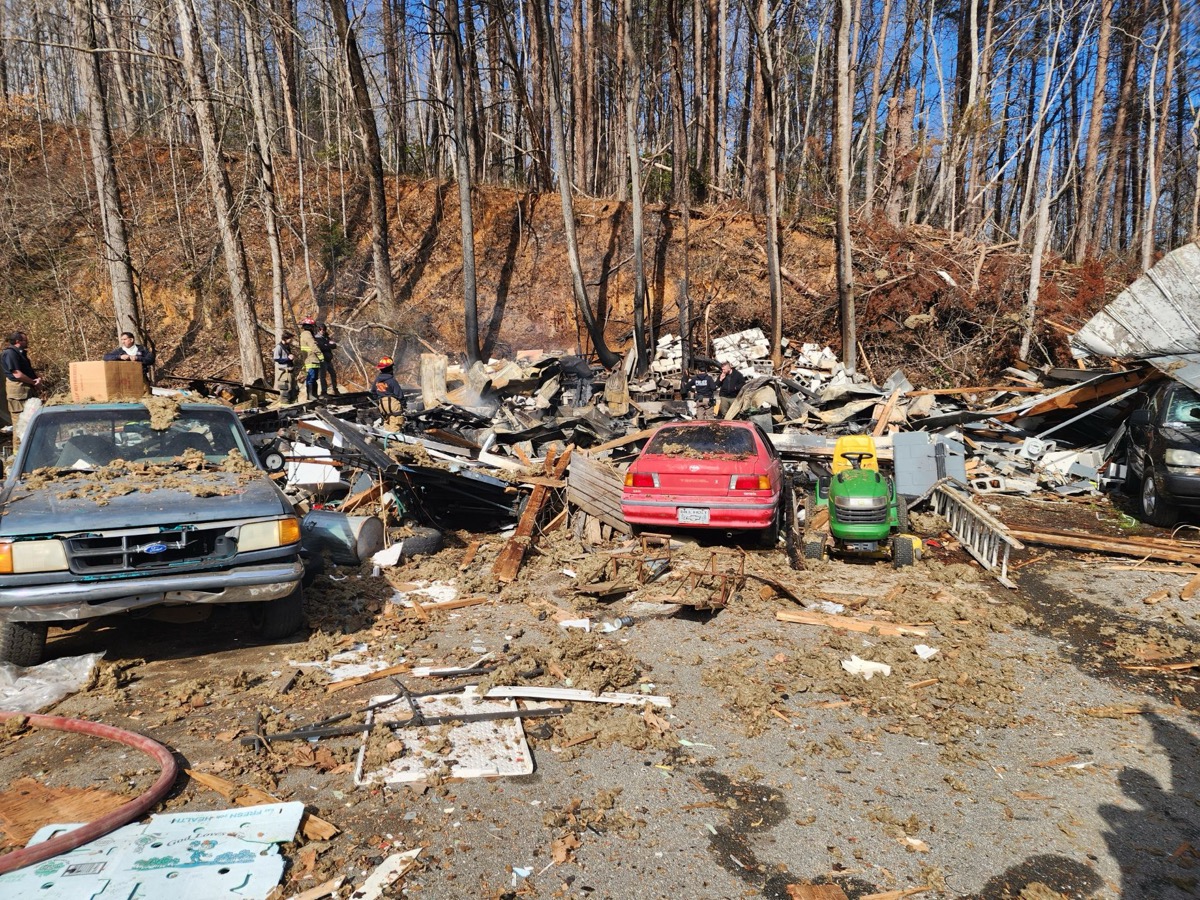
The State Fire Marshal’s Office is investigating the death of 67-year-old Thomas Lee Marcell, a Towns County resident believed to have been killed Sunday morning in a massive home explosion that echoed over a 10-mile radius from its epicenter near Downtown Young Harris.
Investigators are looking into the possibility of a gas explosion, with a preliminary analysis not being able to rule out the accidental ignition of a methane build-up inside the home as the likely cause, according to Deputy State Fire Commissioner Tony Pritchett.
Towns County Coroner Tamela Cooper said there is no reason to believe the victim was anyone other than Marcell at this time, though given the extent of the damage, his body is being sent to the State Medical Examiner’s Office for positive identification.
Next of kin notification was made Sunday evening with relatives who lived out of state, and Cooper has offered condolences to Marcell’s family and friends in the tragic accident.
“Thomas Lee Marcell was a beloved member of the Young Harris community, known for his remarkable skill in repairing guitars, chainsaw motors and gas engines,” Cooper told the newspaper. “His hands could restore the soul of a beloved instrument and bring life back to worn-out machines.
“Thomas was also a world champion boatsman, achieving greatness in the Marcell boats he built alongside his father.
“Thomas was a kind-hearted and generous man, always willing to lend a helping hand to those in need. His presence will be deeply missed, but his legacy of craftsmanship and kindness will live on in the lives he touched.”
Reportedly, Marcell hailed from New York originally and had been renting the property on Brown Circle as living quarters for the past six years. He was the lone occupant of the old cinderblock building that previously served for decades as a garage shop.
No one else was hurt in the incident, but the explosion decimated the roughly 1,000-square-foot structure situated across the highway from Gibson’s Drive-In Restaurant on US 76.
The tremendous blast and resultant fireball blew straight up through the building, charring treetops on the bank behind the home and scattering debris over the area.
Somehow, destruction and fire from the eruption were largely contained to the immediate vicinity of the building, with no major damage to incredibly close-by occupied homes.
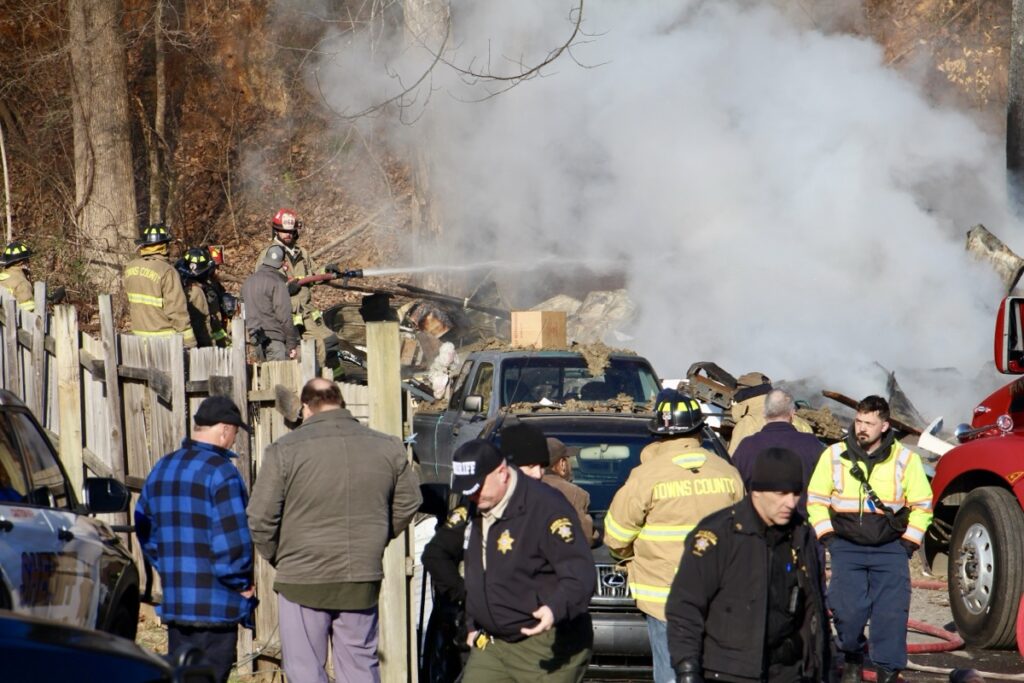
E-911 Dispatch toned the emergency call out at 7:39 a.m. on Feb. 23, and Towns County Fire & Rescue responded with Tanker 1, Tanker 2, Engine 2 and Engine 3 to extinguish the blaze.
Fire Chief Harold Copeland said firefighters quickly learned that a man was in the home at the time of the explosion, and after putting out the flames, they transitioned to the difficult work of recovering his body.
At the Fire Department’s request, the State Fire Marshal’s Office sent three agents to the scene, and Chief Copeland said he also called an excavator company to help move debris at the site.
The fire chief expressed sympathy for the man who lost his life and his loved ones, and he commended the response of his firefighters and all responding agencies, including the State Fire Marshals, Towns County Sheriff’s Office, Towns EMS and the Coroner’s Office.
On the cause of the explosion, Deputy Fire Commissioner Tony Pritchett, who serves directly under Georgia’s Insurance and Safety Fire Commissioner John F. King, said the state office would publish a full press release once the investigation is closed.
“Preliminarily, there are absolutely no signs of any foul play, and at this point … it’s being investigated as a gas build-up inside the building,” Pritchett said. “Right now, we can’t rule out methane. It does not appear to be propane at this point.”
As for an ignition source, Pritchett said they were working to nail down exactly what would have sparked such a blast.
“Any kind of electrical switching in any kind of appliance inside of the structure would be all it would take to ignite whatever kind of gas is in there,” Pritchett said of the scenario being investigated.
And while it is too early to say that the following is what happened, Pritchett explained that sewer gases, like highly flammable methane, can quickly fill a structure if a septic or sewer drain line attached to a plumbing fixture goes dry, such as from non-use or damage.
Drains for fixtures like sinks, showers and toilets are installed with a special fitting called a P-trap that holds a little bit of water to act as a barrier preventing gas from backing up into a building.
It is called a P-trap because the fitting makes the shape of a letter P on its side, designed to hold water in the bend. And a P-trap going dry increases the likelihood of gases like methane seeping into homes, potentially filling spaces to cause extremely hazardous conditions.
Speaking to public safety around the potential for explosions in situations of methane build-up, Pritchett said people need to make sure there is water in the P-trap portion of their drains “to keep that methane gas from coming back into the house.”
This holds true especially for plumbing fixtures that are not used regularly. A precaution people can take in such cases is simply using a bucket to pour enough water into a drain to keep the P-trap filled and prevent a backflow of gas.
“When properly installed, the vent pipe that ventilates the plumbing out of the top of the house will help it a lot,” Pritchett said. “But still, if you don’t have the P-traps properly filled with water, you could still have an issue.”
The deputy fire commissioner said people with this issue can sometimes notice the unpleasant smell of methane in their homes, but it can depend on how a building is laid out or what part of a home residents typically frequent.
“People get used to smells inside their homes as well and it gets to the point to where they don’t even notice it,” Pritchett said. “I don’t know if that’s the case in this situation.
“Also, it’s possible that methane can come in overnight when somebody’s sleeping, or it can happen pretty sporadic. And there’s so much of that that’s built up in septic tanks a lot of times that it doesn’t take long at all to fill a structure up.”
Pritchett said that if anyone notices any kind of suspicious smell to call the Fire Department and have them come check it for potentially dangerous exposures, and “they’ll want to get a plumber out there.”
People with propane running to their homes should make sure everything is installed correctly by professionals who are qualified to do it, he said.
“And we really urge everybody to have a home multi-gas detector to pick up on anything like that,” Pritchett said. “That way, if you can’t smell it, at least that detector’s going to pick up on it.”
Though relatively rare, Pritchett said that, sadly, there are usually four or five structure explosions across Georgia each year.
“Sometimes it’s propane, sometimes it’s methane – it just really depends on the situation,” Pritchett said. “The majority of the time, if somebody’s in the building, they are almost always fatal because of the blast, and it’s hard for anybody to survive that.”