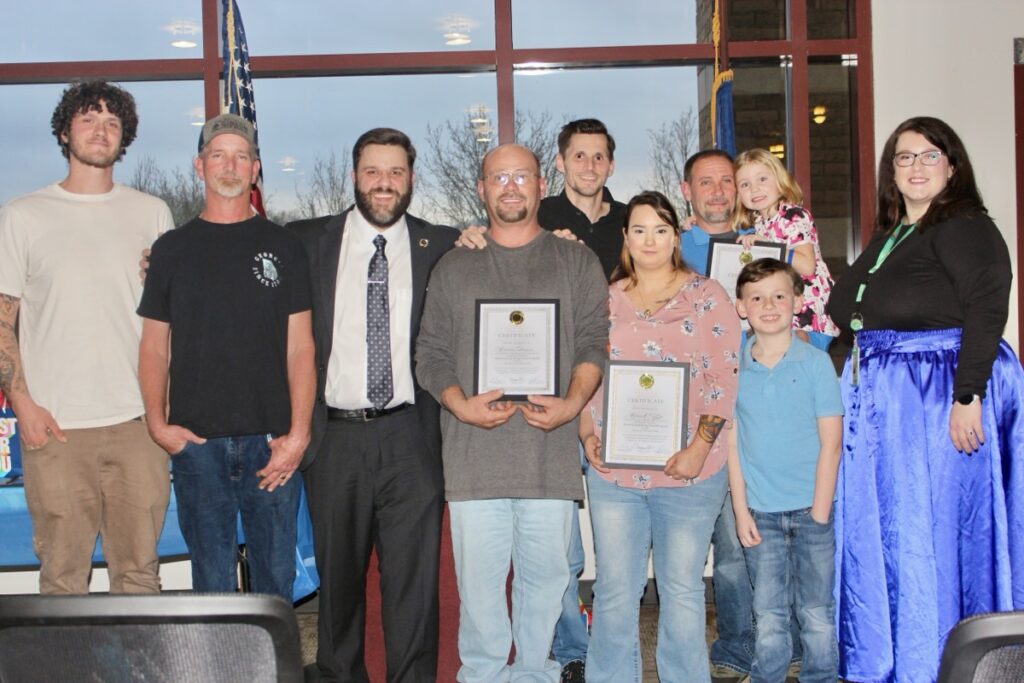
The North Enotah Drug Court and Parental Accountability Court held their first joint graduation at North Georgia Technical College on Thursday, Feb. 6.
There were 11 graduates total, though one was unable to attend: six from Union County, one from Towns County, as well as four South Enotah graduates, three from White County and one from Lumpkin County.
Drug Court Coordinator Amanda Bryant said such graduations serve a twofold purpose: not only do they allow people to celebrate how far they’ve come after what are usually the lowest points of their lives, but their family and friends get a chance to congratulate them also.
And there’s a bonus to opening the graduations to the public; Bryant hopes it helps shatter the stigma around addiction and mental health battles.
Accountability courts are meant to offer rehabilitation, cutting down on the likelihood of repeat offenses by giving non-violent drug charge defendants a chance to treat the problems that brought them to court in the first place.
Those who go down that path to bettering themselves are subject to extensive judicial monitoring. This includes regular drug testing and court-imposed sanctions, but there are benefits for those going through the program.
Counseling to address the behavioral issues and trauma that usually lead to substance abuse is part of the deal along with educational, vocational and life-skill training as well as socialization. Depending on individual cases, certain incentives and exceptions may be offered.
For example, if a defendant has his or her license revoked and is otherwise eligible for the program, he or she may be allowed to drive to job applications, court dates and other important meetings.
“The image of those scales of justice are always in balance, they’re always right, but as you probably know – and is sometimes the truth – those balanced scales aren’t exactly the way lives get left,” said Hon. T. Buckley “Buck” Levins, Superior Court Judge of the Enotah Circuit. “Our accountability courts are an endeavor to fix and stand in that breach, to recognize when people have journeys that need to be made.”
Levins introduced the program and read off small biographies for each graduate, highlighting their positive traits and the growth he’s seen them accomplish as part of the programs.
“These graduates are an embodiment of how to restore somebody to the person they want to be, the person their families truly always knew and the person that they deserve to be for their children,” Levins added.
Bryant and Levins agreed that the overarching goals of accountability courts of any type are to reunite families and treat people with dignity. Bryant, for her part, sees the programs as successes, judging by the proud graduates and a crowded room full of their loved ones.
District 8 State Rep. Stan Gunter, who administered the keynote address, was of the same opinion.
“When I was a judge and I worked with people in the Drug Court or those who came in front of me in court, I always kept it in mind that … most of the folks who came in front of me were good people who just made bad decisions,” Gunter stated.
Some of the graduates and their families took the opportunity to speak. Britton Barr, a Union County graduate of both programs, was first to share. Now a member of Freedom Ministries, Barr has also found employment at Union General Hospital as a phlebotomist.
“Addiction takes you to depths of water that are so deep, you can’t even see the light,” Barr said, describing his old life as one defined by “(overdoses) and jail.”
“You are sick. You are lost. You need help. I needed help. This program is my saving grace, and I truly believe God intervened in my life at that time.”
Then, Jason Cunningham, a fellow Union County graduate of NEDC, addressed the crowd. Cunningham “has a beautiful future planned” and is proud to be the father he always wanted to be for his daughter.
“I thank God for the strength that he gave me to … get through this, and He helped me to make a change,” Cunningham admitted, also voicing his thanks for the accountability court program. “If you can just imagine a gate, gratitude is the hinge that sobriety swings by.”
Graduates received certificates and challenge coins before treating themselves to refreshments and conversation with court team members and friends they’d made through the program. Many of them, however, were just happy to recognize their new leases on life.
“If you’re dedicated and want that life, that change, (accountability court) is not hard at all,” said Towns County participant Melissa O’Keefe after the graduation. “For any new participants, keep your head up and just look at your peers. And it’ll be good.”