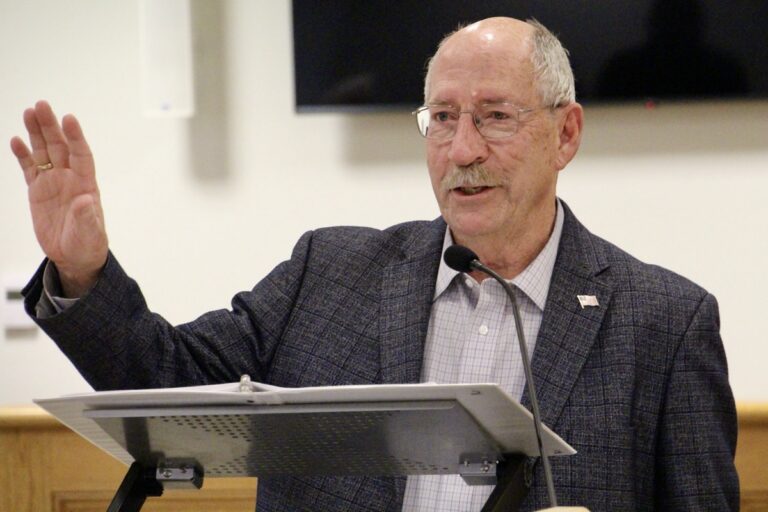
Union County Sole Commissioner Harold Collins set the 2026 Millage Rate in a called meeting on Thursday, Oct. 1, inside the Union County Courthouse. Collins opted to go with the rollback, adopting a new property tax rate of 3.842 mills, which is 0.11 mills below the 2025 rate.
Rollback rates reflect the offsetting value of Local Option Sales Tax collections on gross property taxes. It’s a considerable sum; without the sales tax rollback, the millage rate for Union County Government would be 6.018.
To prevent indirect tax increases due to inflation, the state requires that rollback calculations produce a revenue-neutral levy from year to year, though the county is still projecting greater total property tax collections in 2026.
At 100% collections, the new rate will bring in about $11.6 million in property taxes, which is roughly $280,000 more than in 2025, due largely to actual growth from property improvements and new construction in the county.
Augmenting the lowered mill rate, Gov. Brian Kemp is using a state budget surplus to enact a one-time property tax deduction on eligible homesteads, which in Union County will translate to about $195 being subtracted from the total due on eligible tax bills.
And since the Union County School Board enacted a small tax cut this year, the combined county/school mill rate of 10.432 will make it even more likely that homesteads – and many other property owners – will see smaller tax bills this year.
Property taxes provide maintenance and operations funding for local governments, and millage rates are calculated based on budget projections to provide public services for another year.
So, adopting the rollback means Collins believes the county will be able to maintain operations next year with roughly the same amount of property tax dollars collected in last year’s levy.
The Fiscal Year 2027 Budget is not due for completion until the end of December, but the Commissioner’s Office began preliminary budget considerations back in April before soliciting expenditure requests from the various county departments in June.
According to County Finance Director Kay Wilcox, expenses have been fully calculated for next year’s budget, with work continuing to finalize revenue projections, which is expected to be finished by the end of this month.
For the second year in a row, the county is using “priority-based budgeting,” which tasks department heads with prioritizing funding requests anew each year rather than simply increasing last year’s departmental budgets by the rate of inflation.
Tax Commissioner Lee Knight attended the meeting, and he said the state’s Floating Homestead Exemption, which went into effect last year with an inflation-based reassessment cap, guaranteed that values for eligible properties only went up 2.7% at most unless improvements were made.
“Now that the millage rate is adopted (for the county and school system), we’ll start working on getting all the paperwork to the Georgia Department of Revenue,” Knight said. “We have to have that approved, and then they’ll give us an order to collect.”
Knight said the order to collect should come in sometime this week, after which his office can get to work on mailing tax bills.
“We’ve got the data loaded for the tax bills already in our system,” Knight said. “We do have to adjust the millage rates now that they’ve been set, and we should have those to the printer by midweek, and we expect tax bills to go out somewhere around Oct. 15.”
Property tax bills will be due on Dec. 20, and Knight predicted that the governor’s Property Tax Relief Grant coupled with the Floating Homestead Exemption will result in nearly all homesteaded properties seeing smaller tax bills than in 2025.
“I’ve already been viewing tax bills, and mine’s down about $180,” Knight said. “Most everyone’s tax bill for their homestead will be lower.”
The City of Blairsville will hold a second reading and enactment of its rollback millage rate on Oct. 13 to enable tax bills to be set on properties located within city limits.