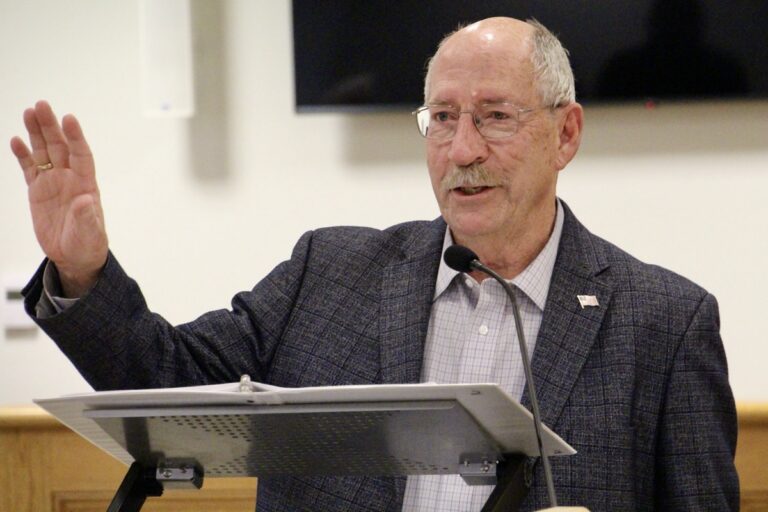
In his June 18 regular meeting, Union County Sole Commissioner Harold Collins once again adopted a resolution approving a Special Purpose Local Option Sales Tax Intergovernmental Agreement with the City of Blairsville regarding disbursement of SPLOST collections.
The agreement is in reference to SPLOST VI, which Collins plans to put before voters as a referendum in the Nov. 3 General Election.
SPLOST VI would be a continuation of the long-running 1% sales tax used for capital projects in the county and city. The county is currently collecting proceeds from SPLOST V, which will expire at the end of March 2027.
In his upcoming county meeting on July 16, Collins is expected to take the next step toward SPLOST VI by adopting a resolution officially calling for voter approval of the sales tax continuation this November.
If the tax succeeds at the ballot box, the city will receive 9% of SPLOST VI collections, which is 0.5% greater than the city’s current distribution under SPLOST V.
This is actually the second time Collins has approved the agreement. He had originally wanted to put the referendum on ballots for the May 2026 General Primary Election, but the vote had to be postponed from May due to the Elections Board missing a legal publication deadline.
In other business, Collins held first readings for a pair of ordinance revisions to tie developments accessing public sewer to minimum lot sizes. This is in direct response to Blairsville’s plans to expand its sewer lines into the county.
Currently, Blairsville’s sewer service east of city limits stops at Hometown Way on Georgia 515, but the extension will see about 2.5 miles of new sewer lines installed to Backyard Lane.
County Attorney William Mercer said the original regulatory vision for development on sewage management systems was to tie development to minimum lot sizes to prevent an overabundance of structures on small parcels, like “10 houses on 1 acre.”
But there was no public sewer access in the county at the time the ordinance sections were drafted, so the revisions simply add public sewer to the county code as a response to growth and development. A public hearing on the revisions will be scheduled and announced soon.
A moratorium is in place to prevent development on properties with access to public sewer in the county until the Commissioner’s Office can finalize the ordinance revisions. The public is encouraged to comment during this period.
Collins also held a second reading of revisions to the county’s “Tower and Antenna Standards” to clear up confusion over what the county means by “preferred placement” of cellphone towers. Some of the original ordinance language was “quasi-contradictory,” Mercer said, creating potential development loopholes.
Additionally, the commissioner accepted a one-year agreement with JAT Consulting Services for “financial management consulting services,” which will cost the county between $125 and $225 an hour.
“This independent financial management consultant will conduct a comprehensive review of the county’s accounting procedures, internal controls, and financial transactions for the Fiscal Year 2025,” Collins said.
He explained that County Finance Director Kay Wilcox had been wanting to do this work herself, “but due to the workload that has come with changing budget procedures and integrating the Recreation Department into the General Fund, she simply does not have the time.”
“The purpose of this review is to ensure the financial practices remain accurate, efficient and compliant with the separate laws, regulations and governmental accounting standards,” Collins said. “The consulting firm will evaluate existing procedures and transactions.
“There have been a lot of changes in the county in the past year, and as with everything finance-wise, it is good to have an extra set of experienced eyes review and assess to make sure everything is even more transparent.”
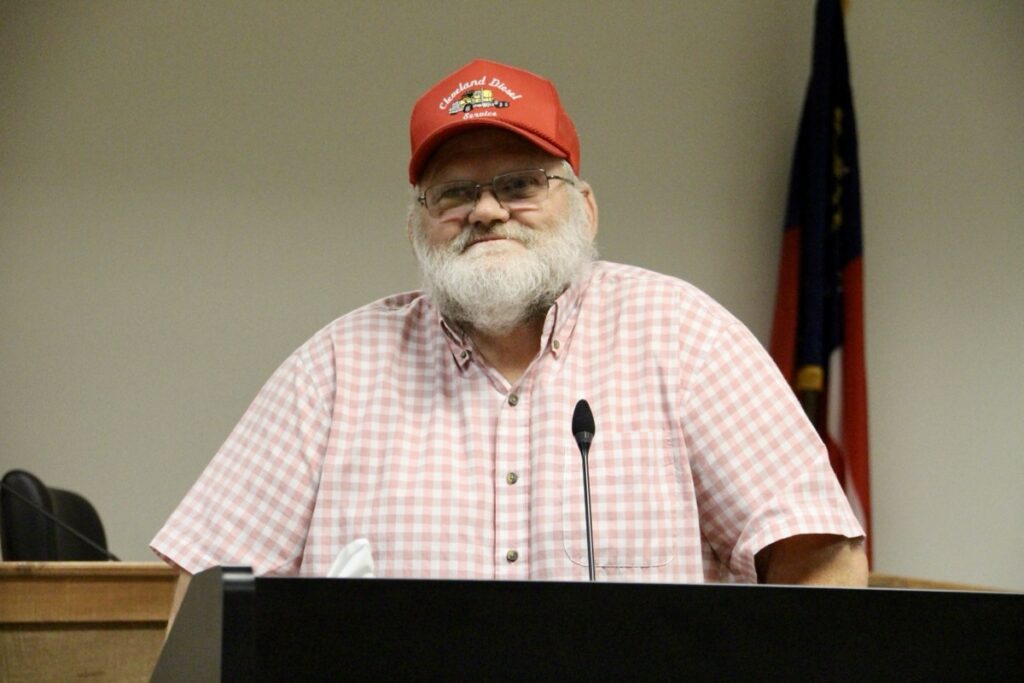
Meeting attendee Vince Peterson asked during the Q&A if there was an upper limit on the consulting agreement, and Wilcox said no while noting that the service features “specific deliverables” the county will be monitoring to keep spending in check.
Among other business, Collins officially approved the $1.6 million LMIG paving contract he awarded last month to Colditz Trucking for asphalt resurfacing on the following roads: 3.26 miles of Pat Colwell Road, from Fall Lane to Nottely Dam Road; 1.32 miles of Pat Haralson Drive, from Murphy Highway to Pleasant Hill Road; and 1.69 miles of Crump Creek Road, from Town Mountain Road to 1680 Crump Creek Road.
After adjourning the meeting, Collins announced that some unenforced rules would be put back into place regarding the public Q&A, namely, a three-minute speaking limit, and restricting questions to items that appear on the meeting agenda.
Regular attendee Kristie Shirkey decried a lack of transparency regarding the rules, which started a brief back-and-forth with Collins, who told Shirkey she had been “under my skin since I took office.” She disagreed, and Mercer had to advise Collins not to argue with her.
Re-implementing the Q&A rules established by his predecessor is in stark contrast to the year and a half Collins has been commissioner.
Prior to last week, Collins imposed no time limits or topic restrictions at meetings, which was in line with his statements on the campaign trail. But he said after the meeting that he had given the open-forum style a fair chance, and people should be able to make their points in three minutes.
“I’ve given everybody as long as they wanted to speak since I took office,” Collins said. “It’s just getting to where a lot of them say the same thing over and over, and people want to go home – they don’t want to spend an hour and a half at a meeting.”
To his point, the May county meeting took 90 minutes to conclude due to a full hour of questions and comments, while the June county meeting lasted just 30 minutes, with about a nine-minute Q&A session under the new rules.
“We’ll see how it goes,” Collins said. “I may change it so you can speak three minutes on anything the next (meeting) after this. So, I’m flexible. I just want to keep the meetings held down to minimal time.”
In the meantime, the commissioner invites anyone with questions or comments to contact his office “anytime” instead of waiting until the regular meeting.
Collins also announced some changes to the next county meeting set for July 16. Instead of the usual 6 p.m. meeting time, the July county meeting will take place at 9:30 a.m. Also, the venue will be moving from the Union County Courthouse to the Union County Sports Center so as not to interfere with regular courthouse business during the day.
He said these changes will allow people to get home earlier and cut down on overtime for security, as the revised meeting time will take place during regular working hours. He pointed out that most meeting attendees are retirees, so he doesn’t think the early meeting time will greatly impact the public.
Collins will try out the new time and venue for a month before deciding whether to return the meeting to the courthouse or perhaps another venue: “We’ll see how it goes – it can all be changed back.”