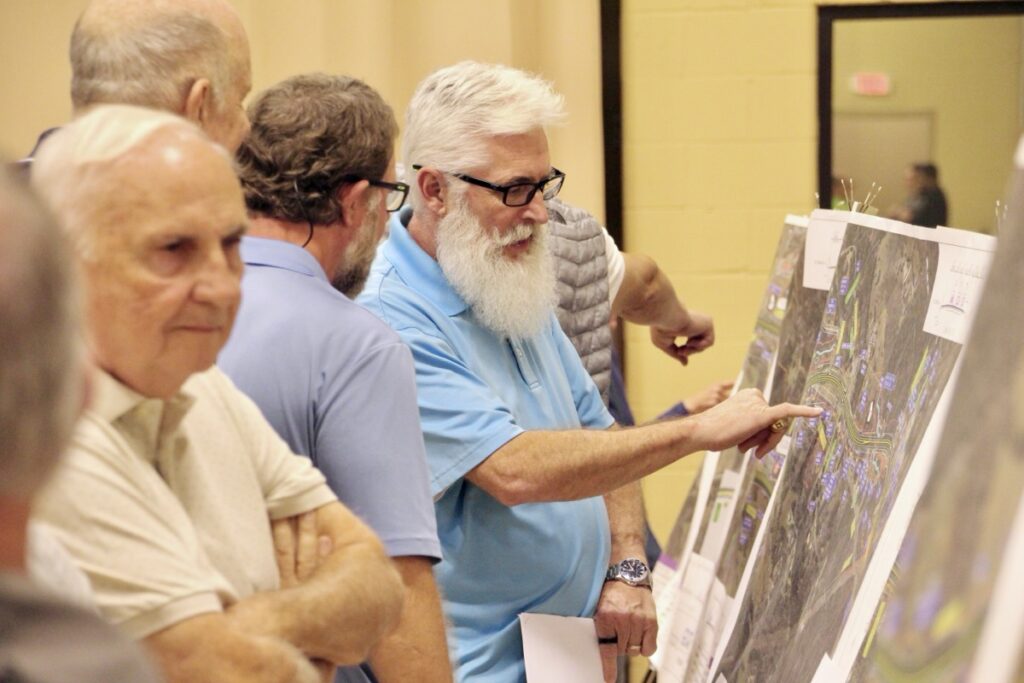
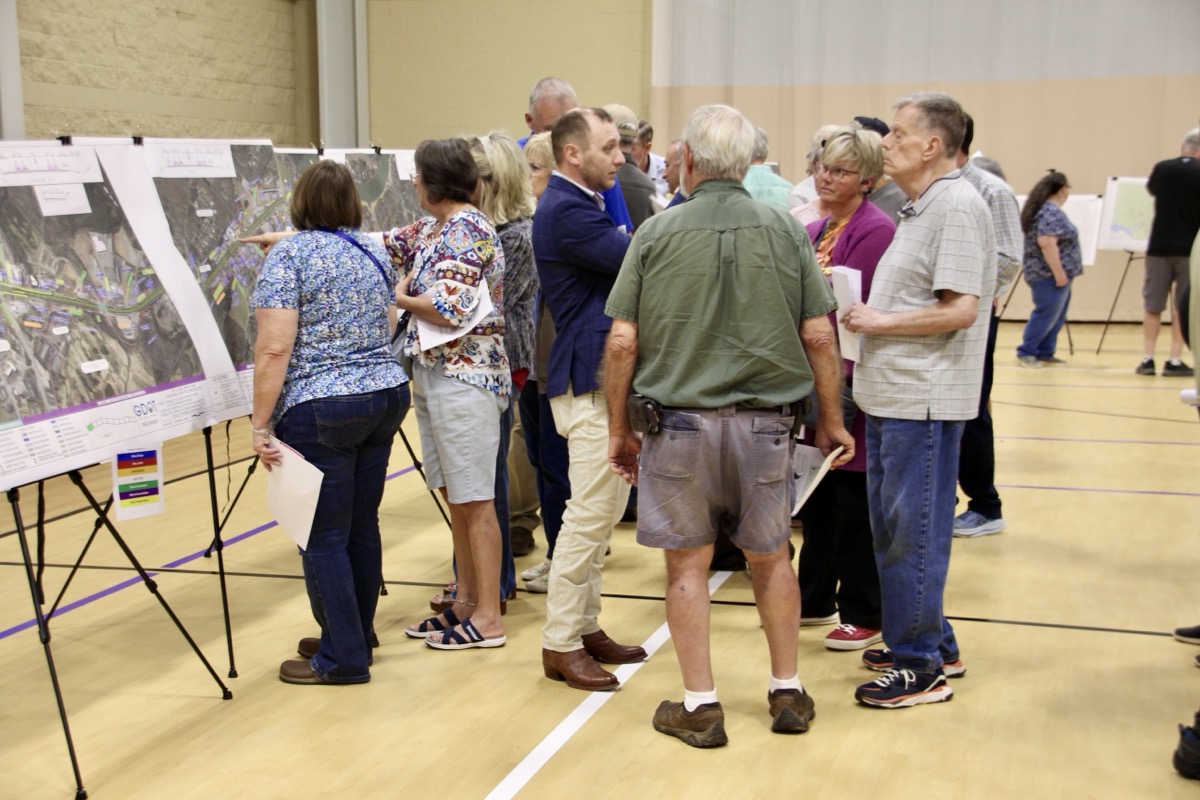
The Murphy Highway Widening Project Public Hearing Open House hosted by the Georgia Department of Transportation welcomed 177 attendees to the Union County Multipurpose Gym on Tuesday, Oct. 6, to share information and solicit community feedback.
GDOT called the meeting because the design plans have changed since the Public Information Open House hosted locally in 2022, requiring the state to inform the community about those changes and seek additional input before finalizing the project.
Updates include revising the roundabout plans at Pat Colwell Road to a Restricted Crossing U-Turn and at Gumlog Road to a traffic signal; the addition of auxiliary lanes “at appropriate locations”; reducing the proposed lanes from four throughout the 8.7-mile project corridor to three in certain areas; the addition of a new bridge to replace a quad box culvert; and fewer side-road detours.
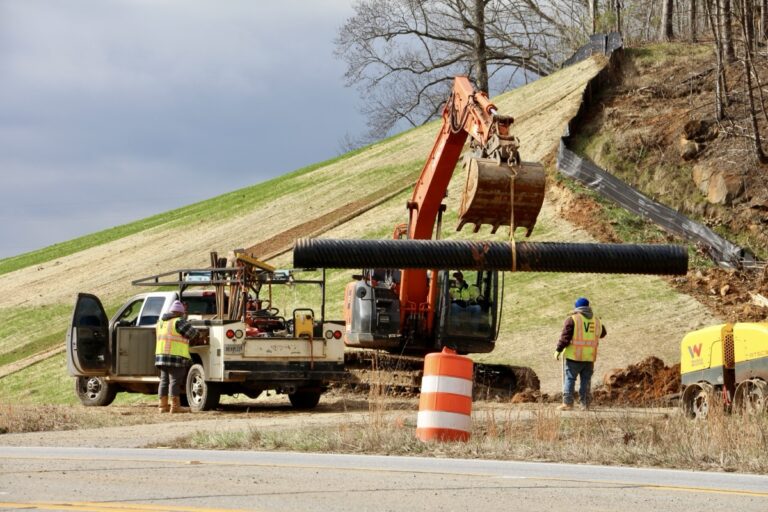
Planning for the project has been in the works for at least two decades, with goals to “reduce crash frequency and severity and to improve operations and safety along the SR 11/US 19/US 129/Murphy Highway corridor” between Blue Ridge Street and Ivylog Road.
The state has split the project into three parts, with the first part estimated to begin construction in 2030, though all dates are subject to change. The state is currently in the final plans phase and aiming to acquire right-of-way in anticipation of getting to work as soon as possible.
GDOT has planned about $48 million in property purchases to convert approximately 200 acres of land to transportation right-of-way along the corridor.
The acquisitions will result in 14 business relocations, 20 residential displacements, and two active churches facing partial property acquisitions, namely Redeemer Baptist Church at 0.63 acres and Unity Church of the Mountains at 0.05 acres.
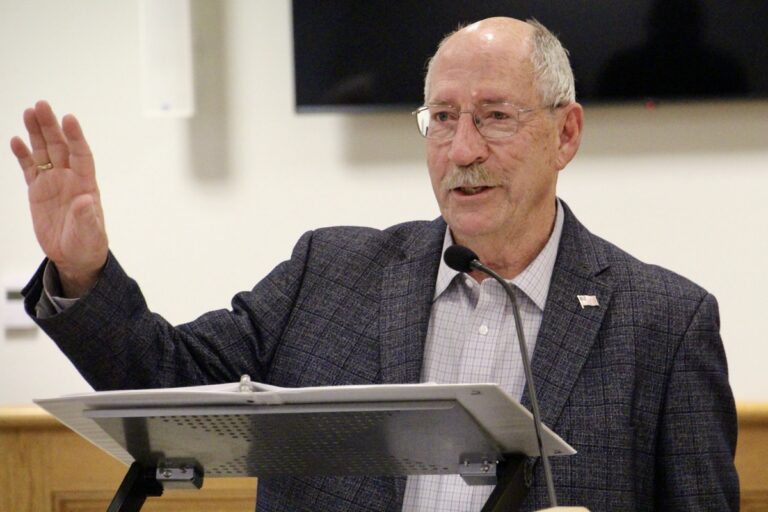
Multiple GDOT employees welcomed the public, setting up two sets of plans on posterboards and easels for people to view the various road sections. Proposed side-road detours and environmental assessments were also available, and friendly GDOT staff answered as many questions as they could.
There was much interest in the re-designed intersection of Pat Colwell Road, with some people in favor of the RCUT, which would have Pat Colwell traffic make a downstream U-turn at the proposed Pat Haralson Road roundabout to head north on Murphy Highway.
However, others did not like the RCUT design, believing it would delay travel and confuse motorists, and several people wondered why the state wasn’t putting a traffic signal there like Gumlog Road.
Opinions seemed largely mixed on the whole, with quite a few attendees in favor of some project aspects but not others, such as the inclusion of roundabouts, though the plans now contain two fewer than originally proposed.
Some people were concerned about the estimated cost of $179 million and the level of disruption that will be caused by multi-year construction, expressing hopes that the major project was actually necessary versus simply adding a few traffic lights to improve problem intersections.
Public safety personnel in attendance noted that while construction would likely impact response times slightly as with any big road project, ultimately, they believed the corridor would be safer when all was said and done.
Many concerns were specific to the intersections nearest to where people live.
For example, two friends who reside in Wesley Mountain Village attended to make sure the state knew their neighborhood was expanding. About 100 new units are coming, creating a concern that increased traffic making left turns across four lanes there would be even less safe than it is now.
A resident of Lakeside Village shared his belief that the proposed intersection redesign at S. Mauney Road and Murphy Highway from a Y-shape to a T would make it harder for motorists to enter from the south.
Still others wondered why the state was relying on crash data that was at least three years old to make its safety case, and some thought the data provided did not support the need for the project, though others were content with the idea of expanding Murphy Highway given growth trends.
Regardless of the concern or opinion expressed, GDOT employees encouraged attendees to leave their thoughts – either in-person that evening or later online – for consideration and potential redesigns by engineers.
For more information and to leave comments, visit https://sr-11-murphy-hwy-widening-0018219-122200-and-0018220-gdot.hub.arcgis.com/. Comments will be accepted through Oct. 23, and people can expect to hear from GDOT about 30 days after the comment period closes.
“After the close of the comment period, feedback will be assessed, (and) revisions may occur to the proposed plan initially brought to the public,” according to GDOT. “Additional refinements to avoid, minimize or mitigate impacts to resources in the project area may also occur at this stage before the preliminary plans are finalized.
“If major changes occur to what was previously shown to the community, additional public outreach will occur. If no major changes are proposed, the project would advance to right-of-way acquisition and into final design. After all right-of-way acquisition occurs, project design is finalized, and the project would advance to construction.”
Phase 1 is the largest part of the project at 5.3 miles in length. Estimated to begin construction in 2030, Murphy Highway will be widened from two to four lanes between GA 515 and Pat Colwell Road.
From there, the highway will be widened to three lanes up to Gumlog Road, alternating between a middle turn lane and passing lanes.
Phase 2 will feature the construction of a roundabout at Murphy Highway and Blue Ridge Street, which is currently a four-way stop, with construction estimated to begin in 2032.
Phase 3 is estimated to start construction in 2033, to include widening 3.4 miles of Murphy Highway from two to three lanes between Gumlog Road and GA 325. The third lane will alternate between a middle turn lane and a passing lane.