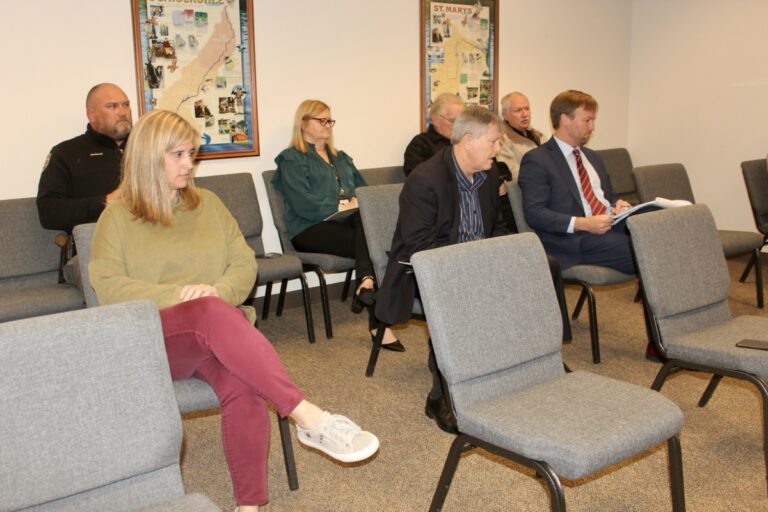
Union County Sheriff’s Sgt. Robert “Bob” Calamari brought his Scam Awareness Class back to the Union County Public Library on Jan. 14, once again informing residents about the risks that lurk in the digital world, the mail and even innocuous-seeming packages on doorsteps.
Also presenting that day were Casey McVay of Tri-State Tech Support and two officials with Georgia Adult Protective Services, Supervisor Emily Shook and Inv. Brandy Warren.
The classes are held regularly to help keep folks up to date on the latest scams; unfortunately, crafty thieves are constantly updating their methods to outwit evolving technology and try to dodge law enforcement officers – like Calamari – who aim to put them away.
Sharing one ongoing case, a victim recently lost thousands of dollars to a “romance scam.” Using deception, scammers enter online relationships with their targets, often pretending to be in vulnerable positions before asking for money.
Another local story involved a woman believing she was speaking to a U.S. Army General allegedly stationed in Sudan. She never talked with him over the phone, but he claimed to need help getting out of the country to return to the United States. In the end, the victim sold many of her belongings and found out the hard way that her beau was not who he claimed to be.
A new tactic that has cropped up in Union County has been the use of publicly available arrest information to steal from concerned family members. Heightened emotions lead to easy prey for scammers, and the bar is never too low for a thief to strike.
Until recently, criminals were contacting the families of those listed on the Union County Jail’s online inmate roster, posing as law enforcement to ask for bail money. Expecting their loved ones to be freed after paying the sum, family members would then go to the jail to pick them up only to find out the truth.
The problem became commonplace enough that on Dec. 24, 2025, the roster was taken down indefinitely to prevent more cases.
“I was able to get the phone number, and I called this individual several times, and we had the ‘I’m a retired Marine’ (conversation), and I gave him a couple of my choice words about calling residents,” Calamari admitted, revealing that he “aggravated” the criminal by repeatedly calling back and hopefully spurring him to abandon the number.
Calamari later received calls from Rabun County and Long County, finding out that both places have been “inundated” with similar scams. For the time being, local arrest reports are only being published in the North Georgia News.
“We are exploring options to begin posting this information online, but we will only do this if we can ensure that our citizens will not be scammed from the utilization of this information,” a recent Facebook post from the Sheriff’s Office stated.
Introduced in a former class were “brushing scams,” where packages are dropped off at someone’s doorstep full of items not ordered by the recipient. The goal of these schemes is to receive reviews on the items, or in the case of electronics like phones, steal digital information.
Sometimes, though, there are more insidious intentions at work. An attendee at the Jan. 14 class shared that they heard of one scammer asking for pills through the mail in such a manner. Calamari himself brought a package that his wife received just a few days before the class. Inside was a bag and bottle, both adorned with biohazard stickers.
No matter the result, it’s enough to unnerve some people that their addresses are floating around for free use. Indeed, Calamari said data breaches can result in billions of individuals’ private information being leaked to the dark web, but there are ways to find out whether one’s sensitive data is in the wrong hands.
Calamari introduced several options to the audience, and everyone who attends the class receives packets with helpful information.
One free site to check out is the National Public Data Breach Check & Search, located at www.npdbreach.com. Searches use first and last names along with a phone number or social security number, and results arrive via email. Alternatively, www.pentester.com requires payment but offers similar services.
People who missed the latest class and wish they had attended need not worry, as classes are scheduled multiple times throughout each year, so stay tuned for date announcements from the Sheriff’s Office.