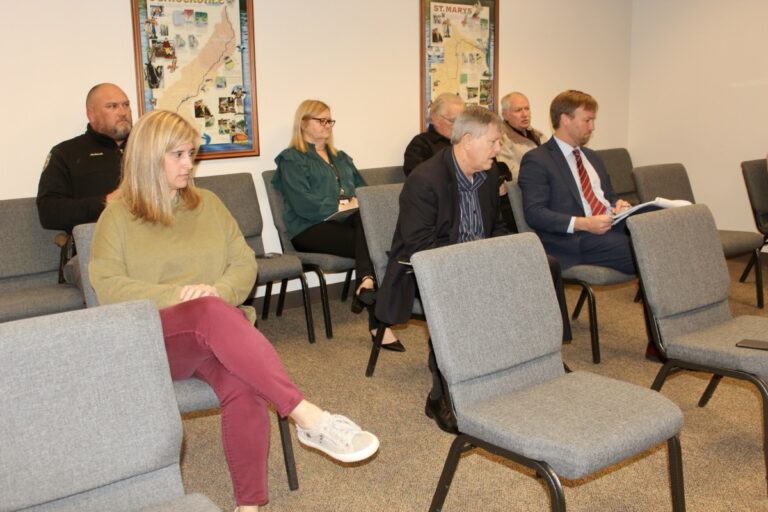
Now that the Union County Sheriff’s Office has given the public an all-around view of the departments that make up local law enforcement, deputies talked about how they interact with the people around them in the Citizens Academy program on Thursday, Aug. 20.
UCSO Lt. Dustin Walker coordinates the 20 hours of training that all deputies must undergo every year. Additionally, he is assigned to the Criminal Investigations Division and also deals with policy development and social media.

Walker started in Union County law enforcement 18 years ago, first working in the jail before making his way to the Blairsville Police Department and the Sheriff’s Office. He has been an instructor for 14 years, and he shared with academy attendees some of his training materials.
He opened the evening by talking about community policing and how modern law enforcement began. Sir Robert Peel is regarded as the father of modern law enforcement; Peel, who died in 1850, transitioned policing from a vigilante and militaristic venture to a practice of peace officers.
August Vollmer, who became the first police chief of Berkeley, California, in the early 20th century, further developed law enforcement into a more structured career, advocating for professionalism and proper training.
Modern community policing relies on tackling the causes of crime and disorder. That can look like building community partnerships with governments and health agencies as well as individuals who serve as the eyes and ears for officers who can’t patrol every inch of a neighborhood at once.
It can also include discouraging crime in the first place. The broken window theory essentially states that serious crimes can be discouraged by tackling smaller crimes. That is, when police help clean up a neighborhood by eliminating property damage like broken windows and graffiti, potential criminals are more likely to be deterred from committing major crimes in that area.
Of course, while dealing with would-be criminals, officers are trained to respond accordingly depending on the behavior of each subject. The goal is always to de-escalate, and according to Walker, the greatest tool an officer can use is their ability to communicate.
If talking doesn’t help, then an officer must use force. Force, sometimes but not always including deadly force, becomes permissible when an officer “reasonably (believes) that such threat or force is necessary to defend themselves or a third party from imminent use of unlawful force.”
In that case, an officer may use anything from pepper spray to a taser, but Walker said he prefers to use a taser due to the risk of the pepper spray impacting those other than the intended target. Of course, in situations that are more dire, an officer may jump immediately to lethal measures.
Specifically, deadly force is employed “to prevent death or great bodily harm to (officers) or to a third party,” or to prevent forcible felonies that involve the use or threat of violence against another person.
“Our first goal is to stop the killing. We’re rushing in there, we’re trying to find what the source of that shooting is, and we’re going to take that person out,” Walker said. “We’re not waiting around, and our guys know what the risks are when they signed up for this job; they’re going to rush in there.”
Narcotics Capt. Tyler Miller returned last week to give citizens an inside view of how tactical situations are handled, such as in the case of a pursuit or a barricaded individual.
“When I first began tactics … everything we trained to do was dynamic. Everything was as fast as we could go,” Miller said. “That’s changed; tactics have changed. Now we’re training to apprehend and place the suspect in custody somewhere outside of the home.”
To give folks a visual of what an approach may look like, Miller shared a training exercise video, and some of the equipment used in various apprehension scenarios was displayed for citizens to look at and touch, including body armor and riot shields.
One of the items that received the most attention was the new drone, which UCSO has had for less than a year. As demonstrated in the video, it allows for a responding team to clear rooms without putting themselves in harm’s way.
A live flight demonstration showcased how the drone’s interface and camera work and how far it can go. In addition, another piece of equipment was brought out. Aptly named a distractor device, the object flashes and makes noise to harmlessly stun a suspect and prevent harm from other parties who may be stuck in the room with them.
This Thursday, the academy is slated to start back up with some tours of the facilities that first responders operate out of, including the jail and new 911 Center that will be opening this year. The five-week course will conclude on Thursday, Sept. 3.