As recently as the 1940s, American chestnut trees covered Appalachia – some tall enough that their photographs confused inexperienced onlookers into mistaking them for redwoods.
But the devastating blight that arrived at the turn of the last century decimated their numbers, leading scientists to look for ways to preserve the species.
Enter Scott Merkle of the University of Georgia Warnell School of Forestry and Natural Resources, who has worked with chestnuts since 1989.
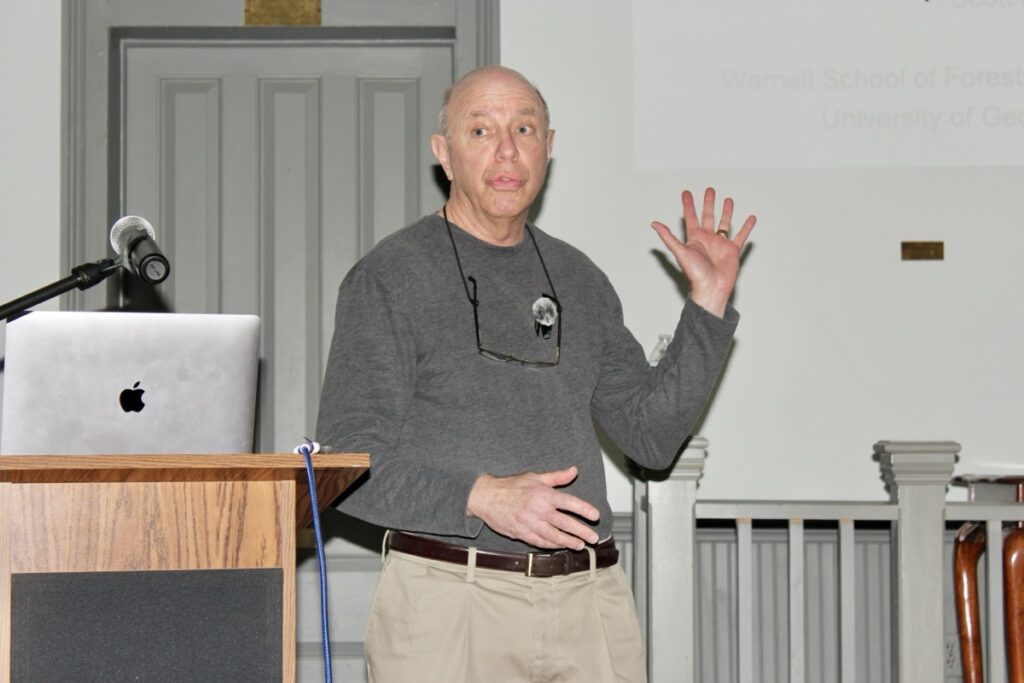
At the invitation of the Union County Historical Society, Merkle presented at the Old Courthouse on March 1, educating the audience on the biology of the treasured chestnut, its significance to Appalachian history, its uses, its downfall and how people like him are attempting to combat its decline.
Chestnuts actually increased in density with the deforestation caused by European colonists who were looking to build a rush of new cabins in the wake of land lotteries; the species thrived in the aftermath due to cleared land leaving ample room for sunlight.
This, combined with their rapid growth rate, allowed the chestnut to flourish. Wildlife and humans alike took advantage of this time of plenty, with the nuts themselves sustaining animals and drawing people out in droves from urban and rural communities.
Roasted as-is or ground into flour, it’s no secret that the American chestnut has been a favorite food for generations. Even today, it’s regarded by some culinary experts as holding a sweeter flavor than other regional variations.
The wood, too, was highly valued. Chestnut wood is rot-resistant, making it invaluable for structures built against the ground or exposed to weather. This durability is due to a high tannin content, which also made chestnut a great asset to properly preserving leather back in the day.
Finally, its straight grain meant that woodcutters could more easily make even slices along the planks for things like shingles, and its lack of smoke while burning made it a popular choice among moonshiners hoping to hide their stills during operation.
So beloved was the chestnut that it was known as the “cradle to grave wood.” In early 1900s Appalachia, it was very likely that many people were lulled to sleep as babies in chestnut cradles, and then, at the end of their lives, were lowered into the ground in chestnut coffins.
At the end of the 19th century, the fungus Cryphonectria parasitica hitched a ride from a shipment of Japanese chestnuts to the Bronx Zoo, then known as the New York Zoological Gardens.
Forester Herman Merkel first noticed a blight on American chestnuts growing on zoo grounds, and by 1905, mycologist William Murrill identified the fungus responsible.
Despite efforts to quarantine the disease and treat infected trees with fungicides, the chestnut blight spread south at a rate of about 20 miles per year. Tell-tale signs of the blight include sunken “cankers” in the bark, as fungal hyphae or mycelium – similar to roots – eat the tree from the inside out with oxalic acid.
The tree dies when the infection spreads around its width, girdling it and rendering it unable to pass water or sugar between the roots and boughs.
It’s estimated that, across the country, about four million trees were killed with the blight’s introduction, resulting in an abundance of a phenomenon known as ghost forests; because of the nature of how the blight killed the trees, they were left standing after their bark was stripped off.
It took the upright dead delayed time to fall, resulting in “clear day thunder” when one of the towering husks fell and sent an audible boom rippling through the forest. And so, the age-old question of whether trees make a sound when they fall in unattended woods was answered.
Make no mistake – the American chestnut is far from extinct. They still grow throughout their old range but are nowhere near the majesty of their glory days; they’re much shorter and yield smaller chestnut outputs. In fact, the vast majority are saplings, and there are approximately four to five million of them growing today.
Depending on location and other environmental factors, many populations undergo a vicious cycle. As the saplings grow, their bark cracks, leaving them susceptible to fungal infections. Inevitably, the young tree dies, and another sapling rises up to take its place for a few years.
Ecologists and scientists have done what they can to mitigate the arboreal apocalypse. In the 1960s, there was an attempt to irradiate chestnut seeds, hoping to stimulate the development of more hardy mutations, but “no one’s really followed up on it.”
Attempts to hybridize the American chestnut with the Chinese chestnut were another popular method. The American Chestnut Foundation spearheaded this movement in the hopes of creating a tree that had all the appearance and functionality of an American chestnut and the blight resistance of the Chinese variety.
Unfortunately, many of these hybrids did not possess the right genes and eventually succumbed to the fungus like their predecessors. This, along with technological advancements in genetic engineering, led to more hands-on measures.
Merkle himself has participated in the process, which can take more than 10 years to complete correctly. Using the genetic makeup of chestnuts from all across the original range, the embryos of tiny trees are grown in a lab, their DNA augmented in a multitude of ways to withstand the blight.
Some survive and some don’t, but even if they did, there are lingering ethical questions and legal limitations in regards to their future.
For now, Merkle continues his research alongside those who want to see a return to the American chestnut’s heyday, with his presentation including a slide thanking his fellow scholars and scientists, as well as the undergraduates who work to achieve the same.
The Historical Society hosted a barbecue luncheon on the Old Courthouse Lawn before the presentation, showcasing its members’ continued commitment to bringing the community together in education and preservation of local heritage.