Daffodils – the flower of spring, sporting vivid yellow petals and a reminder that warmer days are ahead. They also carry with them a rich history laden with poetic symbolism due to their resilience; they are representations of life itself.
This was why, on March 4, nearly 60 people turned out to the Daffodil Project’s Children’s Daffodil Garden Dedication at the pocket park behind Blairsville City Hall, to commemorate the lives and enduring memories of children lost to the Holocaust.

The bulbs have not bloomed yet, but they hold promise, and not just of their own continued survival.
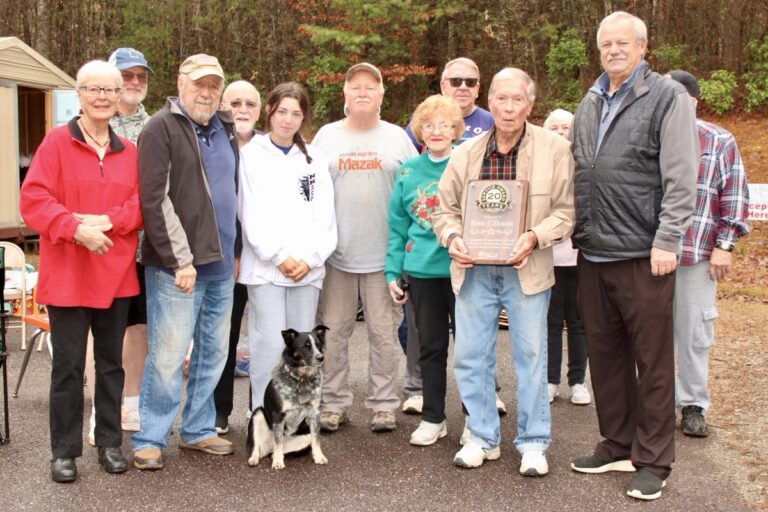
Organized by the Rotary Club of Union County, Chabad Rural Georgia and the Towns/Union Master Gardeners Association, the event was also supported by the City of Blairsville, Blairsville-Union County Chamber of Commerce and the Union County Historical Society among other individuals and organizations.
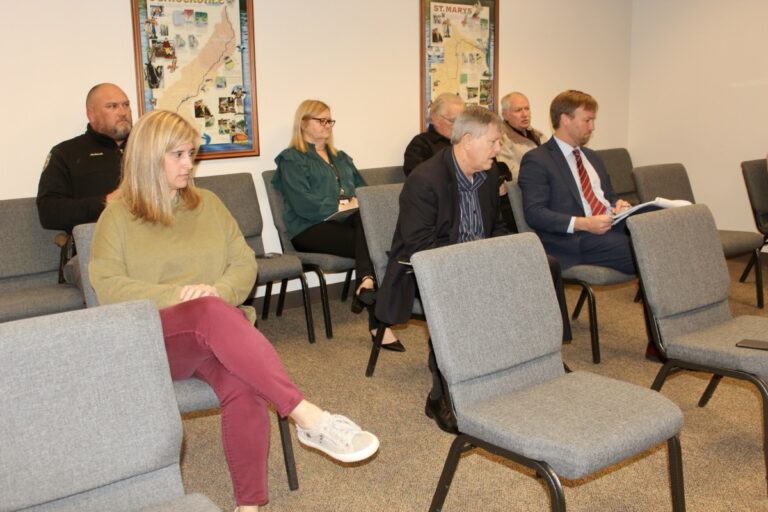
Local Rotary President Patrick “Pat” DeLuca opened the program and welcomed attendees; there were so many that several had to stand after all the chairs were filled. DeLuca shared some sobering math in that each of the daffodils in the garden represented 1,500 children.
Afterward, Grace Howard, a Master Gardener and Daffodil Project Ambassador, talked a bit about the meaning behind the project. Weeping openly, she shared the story of 13-year-old Helen Katz, who was slain at Auschwitz.
Founded in 2008, the international Daffodil Project serves as a living memorial, honoring the memories of the estimated 1.5 million Jewish children murdered during the Holocaust. Some 1,146,787 bulbs have been planted at 662 locations across the world to date.
Along with their endurance and color, daffodils are also reminiscent of the yellow star Jewish people were forced to wear by the Nazis.
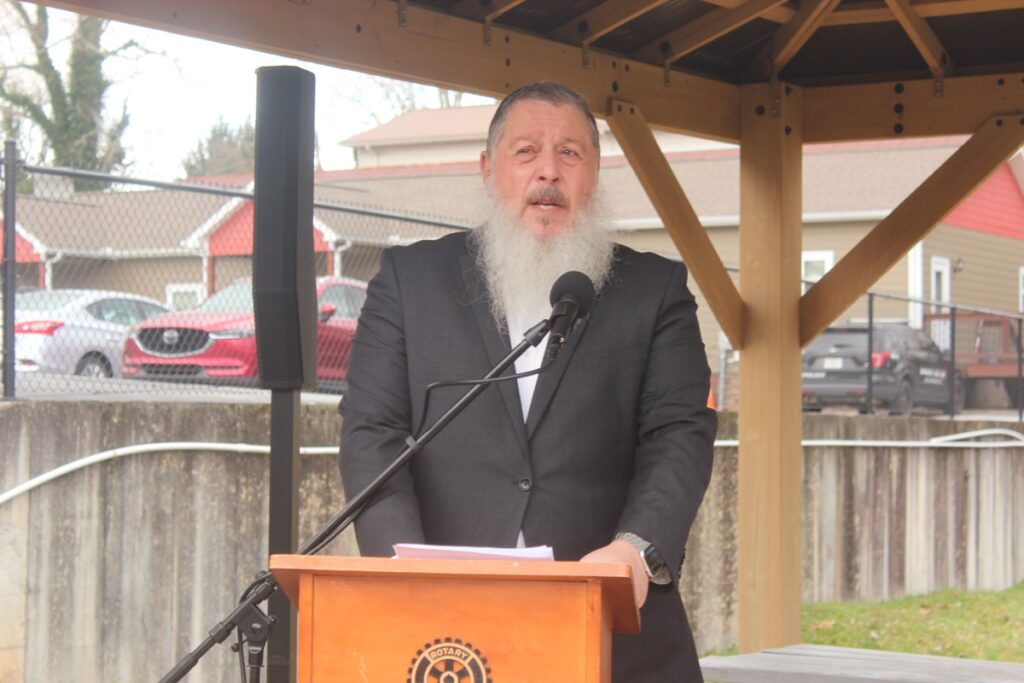
Local Rabbi Yonatan Hambourger opened with a thought exercise. How is it that German soldiers could kill children in concentration camps and then go home to play in the floor with their own sons and daughters?
“The easy answer would be to say that evil people exist in this world, but that answer feels hollow, inadequate,” Hambourger said. “It fails to address the deeper mystery of why God allows suffering to exist at all.”
Eli Wiesel was a teenager when he witnessed the horrors of Auschwitz, but he was also privy to watching a spiritual trial. A group of rabbis and Jewish scholars in his barrack put God on trial for cruelty and betrayal of the Jewish people.
Finding no excuse for their suffering, the verdict was unanimous – guilty. But an interesting thing happened then. Following a heavy silence, the group practiced their evening prayers.
“Questioning the existence of suffering isn’t a sign of weak faith; it’s an expression of our deepest humanity,” Hambourger said. “When we cry out against injustice, when we demand answers to impossible questions, we’re following in the footsteps of our greatest prophets and sages.”
For this, he cited Abraham and Moses, both of whom questioned God when it came to human fate, suffering and doling out His own justice.
“Think of a tapestry,” Hambourger said. “We are viewing it from behind, and it appears chaotic – loose threads, knots, seemingly random patterns. That’s our perspective here on Earth. We see the knots of suffering, the tangled threads of loss.
“But there’s another side to that tapestry, one we can’t yet see, where every thread serves a purpose in creating something beautiful, and that constitutes God’s master plan.”
Hambourger also spoke about the importance of never allowing the same tragedy to be repeated.
“Here’s what I know with certainty – we aren’t meant to be passive observers of suffering,” Hambourger said. “The daffodils we plant aren’t just memorials; they’re calls to action. Each flower whispers to us, ‘What will you do to prevent such darkness from returning?’
“You can’t fight darkness with a stick, but light one small candle, and darkness retreats. Each of us has the power to be that light. When we encounter hatred, we must respond with love. When we see division, we must build bridges. When we witness suffering, we must extend our hands in help.”
Concluding, Hambourger moved audience members with declarations of his own heavy emotions and those of the Jewish community.
“For nearly 2,000 years, my people walked alone,” Hambourger said. “Through crusades, inquisitions, expulsions, pogroms, persecutions and, ultimately, the Holocaust, we looked around and found few friends, few allies, few voices willing to stand beside us.
“Yet today, as I stand together with you in the mountains of North Georgia, I am moved to tears by a profound change in history. You – the Christian community – have become more than friends. You have become family.”
At the end of the ceremony, free daffodil bulbs were given to attendees who felt led to create their own memorial gardens. Along with that, stones were placed along the edge of the bed in accordance with tradition that states visitors to Jewish cemeteries may place rocks near the graves so the dead know they aren’t forgotten.
Certainly, these children, who deserved better and were honored by blooms as vibrant as they are hardy, will never lapse out of memory.
The daffodils carrying their legacies are expected to bloom in the next couple of days to weeks, and the public is invited to the park to see them in their full, dazzling beauty. It is one of two such beds in Blairsville, with the other being located at Meeks Park.